|
I'll be posting some random thoughts here about my photography: my travel plans, technical information behind some images, stories about how certain pictures were captured, etc. The timing of the postings will also be random as my priority is capturing new images rather than writing about existing ones. I hope you will feel free to comment on any of my postings and I appreciate you taking time to read my entries.

The Sand StormDuring most of my time in Iceland, the wind was gusting and the rain was blowing--sideways rain. Late one afternoon, as we were driving to Vestrahorn Mountain (in the Stokksnes peninsula in Southeast Iceland near Hohn), the sky started to open up. Vestrahorn Mountain is one of the most beautiful landscapes I have ever seen. It reminded me very much of the Grand Teton mountain range. Vestrahorn is unique in that there is a black sand beach with sand dunes along the Atlantic Ocean in the foreground. It makes for a world-class landscape location. I was relieved that we were going to have an opportunity to photograph Vestrahorn with some light. Unfortunately, as sunset approached the sky became too clear--no clouds at all. The SUV had a sticker indicating that the rental company was not responsible for wind damage to the doors. The wind is so strong that one has to be very careful when opening a door. It's easy for the door to get caught in the wind. The wind is so extreme that our guide, Tony Prower, would park in such a way that the wind would be blowing from the front of the car to the back--to help avoid having the door swing open too quickly. Tony parked the large SUV near the sand dunes. He warned us to wear eye protection. I assumed that he was concerned about the sun and glare off the beach. However, his concern was with how much sand was blowing in the gusting wind! I left the SUV to start shooting by the sand dunes. Fortunately, the wind was blowing at my back--or this photo shoot would have been impossible. Sand was blowing everywhere. Without glasses, the sand would do major damage to one's eyes. Trying to stabilize the camera was a challenging task. I tried my best to block the wind by positioning the tripod in front of my body about chest high. Changing lenses was not an option. Sand was getting into everything--my hair, my ears, my eyes. It was getting into the knobs of the camera and the tripod legs. I tried to keep my lens facing away from the wind as much as possible as I was concerned that the sand would damage the front element. The sound of the wind was deafening. I felt like I was fighting a war just to capture a few pictures. It's such an incredible location that I kept shooting until the light was gone. Here are a couple of pictures from the photo shoot:
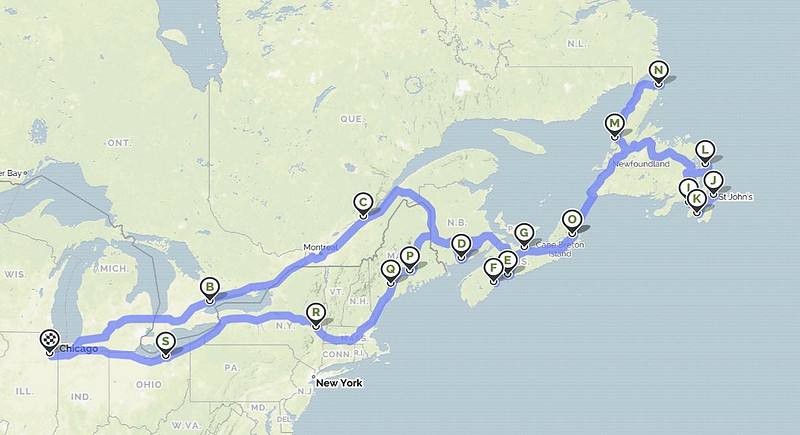
Once we returned to the hotel, I took the tripod into the shower with me to rinse the sand off. I also used an air blower to remove the sand from the camera body. Next Up...Newfoundland!Now that I've returned from Iceland, planning is already underway for my next trip. I plan to drive from Chicago to Newfoundland this summer. This will be a 28 day road trip that will cover more than 5,000 miles. I will spend 9 nights in Nova Scotia and 10 nights in Newfoundland. Once I reach the eastern coast of Nova Scotia, I'll drive my Prius onto the ferry. The ferry will take 17 hours to cross the Atlantic before reaching eastern Newfoundland. Later, I'll return to Nova Scotia from western Newfoundland. The return trip is a 7 hour cruise. I'm hoping for calmer seas than what the ferry experienced in this video:
The logistics involved with planning this trip was more complicated than for my past road trips. In addition to making my usual Hampton Inn reservations, I had to make arrangements with 8 separate B&B's in Nova Scotia and Newfoundland. I also had to make reservations for the ferry (for both me and my car) to get from Nova Scotia to Newfoundland and back. I have rented a cabin for the 17 hour overnight trip to Newfoundland. Here's a preliminary itinerary for this journey:
Day 2: Quebec City, QC Day 3: Saint John, NB Day 4: Halifax, NS - Halifax skyline, Citadel, Halifax Library, Province House, various churches Day 5: Peggy's Cove, NS - Sunset at lighthouse and cove Day 6: Lunenburg, NS - architecture and waterfront Day 7: Lunenburg, NS - churches and harbor Day 8: Pictou, NS - Pictou harbor and Hector Heritage Quay Day 9: Whycocomagh, NS - Cape Breton Highlands National Park; Baddeck lighthouse Day 10: Sydney, NS - Louisnbourg fortress Day 11: Ferry from Nova Scotia to Newfoundland (17 hours) Day 12: St. John's, NL - colorful houses of St. John's, Cape Spear lighthouse Day 13: St. John's, NL - Signal Hill, Ferryland lighthouse Day 13: St. Mary's, NL - Cape St. Mary's Ecological Reserve; Northern Gannets Day 15: St. Mary's, NL - Cape St. Mary's Ecological Reserve Day 16: Bonavista, NL - Village of Trinity, puffins of Elliston Day 17: Bonavista, NL - Bonavista lighthouse, puffins of Elliston; harbor Day 18: Rocky Harbour, NL - Gros Morne National Park Day 19: Rocky Harbour, NL - Gros Morne National Park, Western Brook Pond boat tour Day 20: St. Anthony, NL - fishing village Day 21: St. Anthony, NL - L-anse aux Meadows Vikings settlement Day 22: Channel-Port aux Bosques, NL Day 23: Sydney, NS - ferry from Newfoundland to Nova Scotia (7 hours) Day 24: Bangor, ME Day 25: Albany, NY - State Capitol Day 26: Albany, NY - City Hall, Cathedral of the Immaculate Conception Day 27: Cleveland, OH Day 28: Orland Park, IL The Northern LightsI recently returned from a trip to Iceland. Click here to view my favorite images from this trip. One of the things I hoped to see while in Iceland is the northern lights--or the aurora borealis. Unfortunately, it was raining and overcast during much of my time in Iceland. One night, while staying at the Hotel Smyrlabjorg in Skalafell, the sky opened for a short time and the northern lights made an appearance. Our guide, Tony Prower, was monitoring the aurora forecast and also had a view of the northern sky from his hotel room. Just before 11pm, Tony started knocking on our hotel doors so that we could get outside to capture photographs of the aurora. This is the picture that I captured just steps from the hotel:
The strange thing is that even though I captured this picture, I really didn't get to see the northern lights. Although the camera's sensor recorded the aurora, it wasn't visible to the naked eye. I did see a white cloud that appeared to be brighter than it should be at night. But, I didn't see the green color. And, most of the people around me couldn't see it either. I was pleased to capture the photograph, but it was a little disappointing that I didn't get to see the northern lights with my own eyes! I do very little photography of the night sky, so I asked Tony what settings he would recommend. He said to start with ISO 1600 with a relatively wide aperture (I chose f/3.2) and to see if the shutter speed would be less than 30 seconds. The shutter speed for this shot was 25 seconds. About 20 minutes after I captured this image, the wind picked up again to its customary 35 mph and clouds quickly covered the sky. It snowed for the next few hours. We never saw the northern lights again. Then again, I never saw the northern lights to begin with! Sharpness ThroughoutI commonly use focus stacking to extend the area of sharpness within a photograph. This picture of the Beckman Institute of Advanced Science and Technology at the University of Illinois is an example of a simple two frame blend to render the photograph sharp throughout:
In an image like this, my goal is the render both the foreground object as well as the far more distant building in sharp focus. The foreground object is very close to my lens...the tripod legs were touching the edge of the disk. To accomplish this, I captured two photographs...one focused on the foreground object and the second on the building. I later blended the two exposures in Photoshop to achieve sharpness from front to back. Another method is to use a smaller aperture (f/22, for example) to extend the focus area. However, this foreground object was so close that even a narrow aperture wouldn't render everything sharp. Additionally, sharpness tends to fall off as the aperture becomes smaller due to diffraction. Also, unless your sensor is super clean, f/22 will reveal every single dust particle and make removing all of those spots a more tedious post processing exercise. So, I dial in the sweet spot for my lens (usually about f/8) and focus stack multiple frames. That way, I have the best of both worlds--the use of the sharpest aperture for my particular lens and an extremely wide area of sharpness. Iceland Photos are Available for ViewingLast night, I finished processing the images from my Iceland trip. CLICK HERE to view my favorite photographs from the trip. To view more pictures, by major subject matter categories, please click here. I participated in a photography tour of the southern coast of Iceland led by Tony Prower. I arrived in Reykjavik a few days prior to the tour to explore the capitol city on my own. The weather was challenging through most of the trip. We experienced rain and high winds the vast majority of the time. Fortunately, we usually had a couple of hours of decent light each day--which enabled me to capture some photographs. I will be posting several blog entries in the upcoming weeks about some of the photo shoots in Iceland.
"The Great Hall" Wins Photo of the Day!This morning, my "The Great Hall" picture won Imaging Resource's "Photo of the Day". CLICK HERE to view Imaging Resource's Photo of the Day page. This photograph was captured just a few weeks ago during my visit to the University of Illinois at Urbana-Champaign. I posted a blog entry about the Great Hall recently.
This marks the 49th time that one of my photographs was recognized by Imaging Resource as its "Photo of the Day". Click here to view all of the winning entries over the past few years.
The Great HallEarlier this month, I had the pleasure of having a couple of hours of private access to the Great Hall of the Krannert Center of Performing Arts at the University of Illinois at Urbana-Champaign. This is one of the top acoustical theaters in the world. For years, the Chicago Symphony Orchestra commuted the 150 miles to Urbana to make its recordings.
To view more photographs from my visit, please click here. The Background EraserI recently attended my cousin's fifth grade band/orchestra concert. The students have only been playing for a month or so--and they sounded quite good considering their inexperience. I hoped to capture some photographs of the event, but found the conditions to be very challenging for photography. First, there were a lot more people at the concert than I expected:
The next challenge was the positioning of the musicians. The band and orchestra are facing each other on the gym floor and the two don't play at the same time. So, when I'm photographing the band director (who is facing me), the musicians in the background are just sitting there--and it looks very unnatural. I had to watch the background closely and activate the shutter at the most appropriate times. The biggest challenge was the busy backgrounds. When shooting with a middle aperture, there's so much going on in the frame that it's difficult to tell what the subject is. So, I used my Nikon 300 2.8 and set the aperture wide open. At f/2.8, the depth of field of acceptable focus is very narrow--which helps to isolate the subject. I sometimes call the 300 2.8 lens my "background eraser." Here are some images from the concert:
"Milwaukee Art Museum" Wins Photo of the Day!This morning, my "Milwaukee Art Museum" picture won Imaging Resource's "Photo of the Day". CLICK HERE to view Imaging Resource's Photo of the Day page. This is the first picture from my "Wisconsin Architecture" trip to be recognized with a Photo of the Day. This photograph was captured late last year in downtown Milwaukee.
This marks the 48th time that one of my photographs was recognized by Imaging Resource as its "Photo of the Day". Click here to view all of the winning entries over the past few years.
Dances With WolvesDuring my visit to the Brookfield Zoo last week, I captured this photograph of a Mexican Gray Wolf:
I really wanted to capture this image. I loved how the color of his eyes matched the color of the background. I liked how his fur was backlit and raised behind his body due to the strong wind. And, I liked how he was peeking over his tail. The problem is that he wouldn't look my way! Fortunately, nobody was on hand to shoot the behind the scenes video. All I needed was for him to open his eyes and look at me. So, in addition to making all kinds of strange sounds (which weren't effective), I started dancing around--"Dances With Wolves"--and waving my arms (which was effective). So, he gave me a look...and I thanked him and moved on. |