
Freezing Action with Strobe
It doesn't always take a fast shutter speed to freeze a moving subject. When a flash unit is the primary light source, one can rely on the short burst of light from the strobe to freeze action.
For the following photograph, I manually set the exposure on the camera (1/200th, f/18, ISO 200) to ensure that the ambient light in the room would not contribute to the overall exposure. Without flash, this image would be severely underexposed. Then, I introduced a flash unit (Nikon SB-800) and manually set the power of the flash to provide the desired exposure. Since the flash duration is so short (probably about 1/10,000th of a second at a low power setting), the moving subject gets stopped in its tracks!
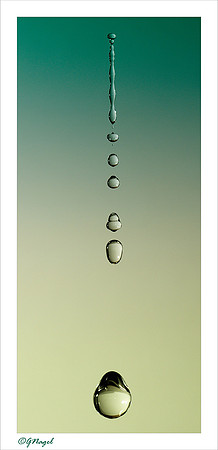 Water droplets
 This technique also comes in handy when shooting certain sports in poorly lit gymnasiums. For this volleyball image, I manually set the camera so that the ambient light was underexposed by approximately two stops (1/250th, f/3.2, ISO 400). Without flash, this image would have been quite dark. Then, I manually set the power for the bounced flash to achieve my desired exposure. This required setting both a Nikon SB-800 and Nikon SB-900 at 1/4 power. Since the strobe is contributing significantly to the overall exposure, it is sufficient to freeze the action. Even at the relatively slow shutter speed of 1/250th, the volleyball and player are quite sharp.
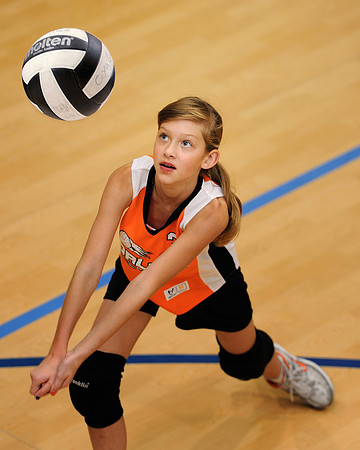 OYA girls volleyball
Comments
I recently shot a volleyball game where flash was prohibited. I asked if it would be OK to use flash during the pregame warm ups--and permission for that was granted. At least I captured several good "action" shots before the match. I then boosted my ISO for the shots during the match--and ended up converting all of them to black & white in an attempt to salvage some decent images!