
Isolating a Subject

When taking pictures of animals in captivity, I tend to select a very wide aperture. Wide apertures, or lower f/stop numbers, narrow the depth of field of the area within the frame that is in sharp focus. Since viewers will tend to look first at the sharpest element in the frame, this technique will literally focus the viewer's attention on the subject.
Often times, subjects are positioned in front of busy and distracting backgrounds. A narrow depth of field helps eliminate distracting backgrounds by blurring them. Some photographers refer to the super-telephoto lenses with very wide apertures as "background erasers"!
Wide apertures also allow more light to enter the lens--which results in faster shutter speeds to achieve the desired exposure. Fast shutter speeds increase the chance of getting sharp photographs, especially when the subject is an animal that is moving.
While visiting the Brookfield Zoo, I used a wide aperture to isolate this orangutan in the Tropic World exhibit.
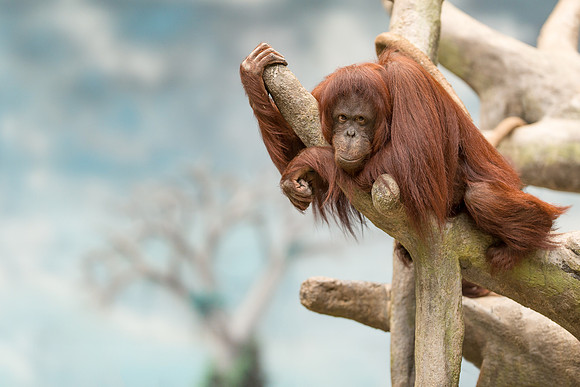 Orangutan
 It's the narrow depth of field that contributes to the three dimensional appearance of this image. I selected an aperture of f/2 for this photograph. A depth of field calculator (available for free through a quick Google search) tells me that the depth of field for this photograph was about 9 feet. I used a 200mm lens at f/2 from a distance of about 100 feet from my subject. This means that the acceptable field of sharp focus starts at about 5 feet in front of the orangutan and ends at about 4 feet behind her. That tree in the background is probably 70 feet behind the orangutan--well beyond the four feet within the focus range--which is why it appears so soft. Clearly, the more distance between the subject and the background, the greater the blur.
I captured this photograph of a snow leopard cub earlier this week at f/2.8 with a 300mm lens:
 Snow leopard cubFour month old snow leopard (Panthera uncia) cub, Everest (born June 13, 2013) at the Brookfield Zoo in Brookfield, Illinois on October 7, 2013