
The Security Guard Photographer

Yesterday, I visited the Palmer House in Chicago to photograph its lobby. The Palmer House opened its doors on September 26, 1871, but burned down just 13 days later in the Great Chicago Fire. It was rebuilt in 1875.
One of my photography books pointed out that the Palmer House management may not allow you to shoot if you come in with a big camera or tripod. It suggested that you can usually get away with handholding a smaller camera and that with a small camera you have a better chance of not being hassled. So, I went with my tried and true method of "shoot first and answer questions later". I located a vantage point above the staircase on the north side of the lobby, quickly set up my tripod and started firing away.
The problem is that the lobby was rather crowded. I was interested in capturing a number of exposures so that I could blend them together later during post processing to create a high dynamic range photograph. The high dynamic range image would allow me to retain more details in the light fixtures in particular. By the time I reached my third or fourth exposure, someone would usually walk right in front of the camera. I didn't have much before it appeared that security would become an issue.
As I anticipated, it didn't take very long before a security guard approached me. He asked me what I was doing. When I started to explain that I hoped to capture a few photos of the lobby, he stopped me to elaborate that his question was regarding my choice of lens, how many exposures, and so forth. The security guard said that he was just getting interested in photography.
With that implied permission to continue, I then spent the next 20 minutes waiting to get better shots--shots that were more carefully framed and with people positioned in a better way throughout the scene.
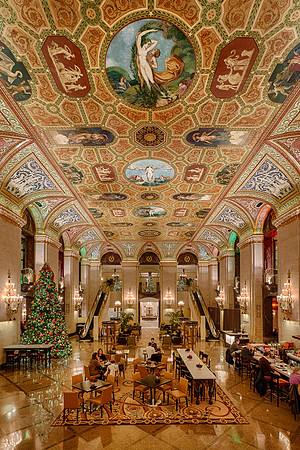 Palmer House HotelLobby of the Palmer House Hotel (1875) at 17 E Monroe Street in Chicago, Illinois on December 18, 2013. The Palmer House opened on September 26, 1871, but burned down just 13 days later in the Great Chicago Fire. This photograph consists of five exposures blended together to create a high dynamic range (HDR) image.
