
Stay Parallel to Minimize Distortion

Over the past year, I have found myself reaching for the Nikon 14-24 2.8 lens more frequently. When I first started shooting with this lens, I found it challenging to deal with vertical distortion--particularly at the wide end of the zoom.
Sometimes vertical distortion is unavoidable or even desirable. This photograph of the interior of the dome of the Michigan State Capitol was captured at the 14mm focal length. I was forced to tilt the camera up to get all of the elements within the frame. As a result, you'll notice that the outside arches are tilting dramatically toward the center of the frame.
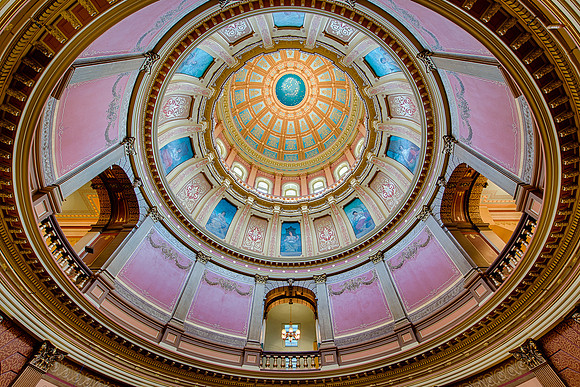 Interior capitol dome
 While I found the vertical distortion to be tolerable in the above photograph, the vast majority of the time I try my best to eliminate distortion. The most effective method for minimizing vertical distortion is to keep the sensor plane parallel with the subject; that is, do not tilt the camera up or down at all relative to the subject.
This next picture was also captured at the 14mm focal length. I was careful to align the sensor plane so that it was parallel to the back wall of the Senate chamber. Note how the lines are relatively straight throughout the image:
 The biggest issue with keeping the sensor plane parallel is that the subject might then fall higher or lower in the frame than you desire. A tilt-shift lens certainly would help resolve that issue. However, I haven't yet been able to justify purchasing a tilt-shift lens. For one thing, they are expensive. Then, they are available only in fixed focal lengths--so I might need three of them! Finally, they would take up room and add to the weight in my already heavy camera bag for a very specialized use. Having said all that, there might come a day when I find that I really need one!
In any event, the way that I deal with the tilt-shift issue is to take advantage of the cropping flexibility offered through the massive Nikon D800 files. I simply crop the top or bottom of the frame to suit the image--and usually end up with a file that is still much larger than the uncropped file generated by my Nikon D700!
Here's another example of the parallel approach using a horizontal orientation of the House of Representatives chamber:
Comments
Thanks for your rely, I appreciate it! Regarding the virtual horizon, I have a similar feature on my Canon 5D Mk III so I'll make use of that as you suggested. I'll also check out the Perspective Crop tool in Photoshop which I have not used.
To ensure that the sensor plane is parallel to the subject, I rely mostly on the Virtual Horizon feature of the Nikon D800. You may refer to an earlier blog post about this feature which is located here:
http://www.nagelphotography.com/blog/2012/12/virtual-horizon
If there is any distortion remaining, I try to take care of it during post processing. One of my favorite tools for removing the distortion is the Perspective Crop tool within Photoshop. I wrote about how I apply this technique in an earlier blog entry located here:
http://www.nagelphotography.com/blog/2013/1/evolution-of-a-picture
Thanks, Glenn