
Frozen Lighthouse

I visited Saint Joseph, Michigan to photograph the historic lighthouses on a cold, Winter afternoon. The outer lighthouse on the North Pier was most interesting to me because of how the ice accumulated on the structure. Lake Michigan gets very rough at times and looks more like an ocean than a lake! The high waves spray water all over the lighthouse. Then, when the temperatures drop, the water freezes into an amazing ice sculpture.
I learned of this spectacular location by reading the Nikon Cafe photography forum. I was inspired by another Chicago area photographer, Frank Angileri, who shared some photographs from a recent trip that he made to the lighthouse. He also provided me with sound advice on how to approach the photo shoot. Most importantly, Frank cautioned me about staying safe out there on the ice!
I arrived in Saint Joseph at about 3:00 PM. My plan was to start by walking to the end of the North Pier to take some close, wide angle, photographs of the outer ice-covered lighthouse. However, as Frank warned, to reach the second lighthouse, one must first walk around the first lighthouse. But, the narrow path on the side of the first lighthouse was covered with solid ice. Additionally, the wall of the lighthouse was covered with ice. And, there are no railings!
Given the freezing temperature of the water and the distance of the lighthouse from the shore, the chances of surviving a fall into the lake are slim. As Frank mentioned, "it would not end well." So, with a heavy backpack containing my camera, four lenses and a tripod on my back, I decided not to risk the walk around the first lighthouse and turned back.
Here's a picture of the two lighthouses on the North Pier:
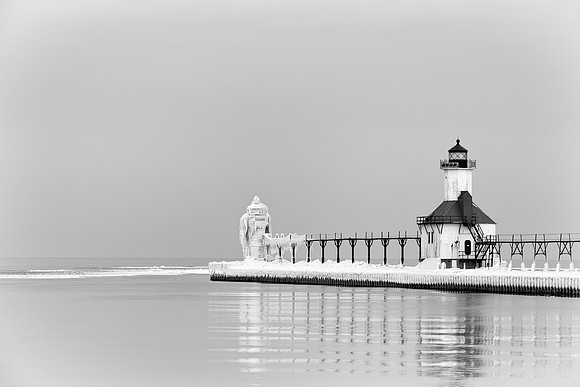 Double lighthouses (B&W version)
Fortunately, there is another pier, the South Pier, which provides some excellent views of the lighthouses. So, I drove over to Silver Beach and walked down the South Pier. I enjoyed shooting the lighthouses for a couple of hours in some nice late afternoon light. However, my favorite photographs came after the sun went down!
A few accessories helped make the icy conditions more tolerable. First, I quickly strapped some Kahtoola MICROspikes over my boots to help with my traction. Also, I like to wear mittens that fold down to reveal finger-less gloves to keep my hands warm while giving me the ability to work the camera with my fingers.
I was hoping that the ice-covered lighthouse would light up while I was there. And, I wanted to photograph an illuminated lighthouse before the sky got too dark. The camera's sensor is capable of recording some great colors well after sunset. But, the images lose color and get far more contrasty when the sky goes completely black. I usually like to shoot for about 20 minutes after the sun goes down.
At sunset, the light in the window of the lighthouse went on. It was flashing and quite dim. The light would go on for a second, then off for three seconds, then back on for another second. I wasn't sure what to expect, but decided to try a few exposures. Since I had my tripod, shutter speed wasn't an important consideration. I first set my camera for a sharp, middle of the road, aperture (f/9). Then, I selected the lowest possible ISO (closest to the camera's base ISO of 100) for the highest possible image quality. In this case, ISO 160 was the setting for a shutter speed of 30 seconds. As always, I set my camera for Mirror Lock Up and used a cable release to minimize any vibration. And, I also set my Long Exposure Noise Reduction to ON to minimize any noise associated with heat building up on the sensor from such a long exposure.
I wasn't expecting much at first, but was pleasantly surprised when I saw the image appear on the LCD panel on the rear of the camera. I was expecting the window light to get blown out and appear as a bright overexposed ball. But, because the light was dim and only stayed lit for about 8 seconds during the exposure, the light appears soft and warm in the photograph.
While processing this image, I decided to make it a composite. Earlier, I had photographed a full moon. I blended that image of the moon with this image of the lighthouse to create a composite image that contained both subjects in the same frame.
 Frozen lighthouse