
Surprising Tripod Restrictions!

The tripod is one of the most important tools for my photography. A tripod allows me to:
- Select the base ISO setting of 100 to achieve optimal image quality
- Stop the lens down to maximize the depth of field.
- Expand the dynamic range by bracketing exposures.
- More carefully compose the image and ensure that the lines are straight.
Without the tripod, some of these images become snapshots--at best.
In certain locations such as museums, I expect that the policy will not permit tripods. However, during my recent trip to the Southeast, I was surprised and disappointed by a few of the locations at which tripods were prohibited.
Surprise Situation #1 - The Martin Luther King, Jr. National Historic Site:
I assumed that tripods would be prohibited inside the Visitor Center. However, I did not expect to be told to put my tripod away while shooting outside in the Peace Plaza. It was about 4:00 PM on a weekday and I was the only person at the plaza. I was composing a photo of the Eternal Flame when I noticed a park ranger approaching me. He informed me that tripods weren't permitted and asked me to fold it up immediately. I asked him my why tripods weren't allowed outside as this was the first time I encountered such a policy within a National Park site. He said that the tripod looked "too much like a weapon" and that "this is the America we now live in". So, it's OK to walk around with something that resembles a weapon--but it's not OK to place a camera on it to make it obvious that it's a tool for photography?
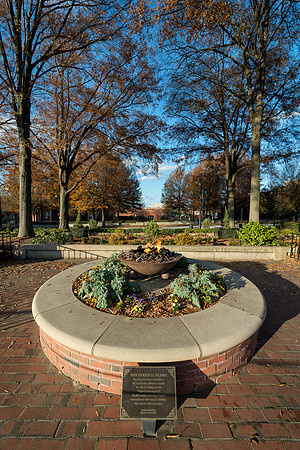 The Eternal FlameThe Eternal Flame at the King Center at 449 Auburn Avenue NE in Atlanta, Georgia on December 2, 2014. The Eternal Flame symbolizes the continuing effort to realize Dr. King's ideals for the "Beloved Community" which requires lasting personal commitment that cannot weaken when faced with obstacles.
Surprise Situation #2 - The North Carolina State Capitol
As I entered the North Carolina State Capitol building, I was surprised when the security guard told me that it was OK to carry the tripod into the building, but not OK to place the camera on top of it to take photographs. The reason this is so surprising is that North Carolina is the only capitol with a tripod restriction of the 39 capitol buildings that I've toured so far. I revisited twice more--hoping that a combination of a different security guard and entering the building during a quiet time might change the outcome. During my second attempt, I was the only person in the building--but the tripod was still not permitted. It was frustrating to try to capture images of the chambers by hand--when my tripod was sitting on the floor right by my side.
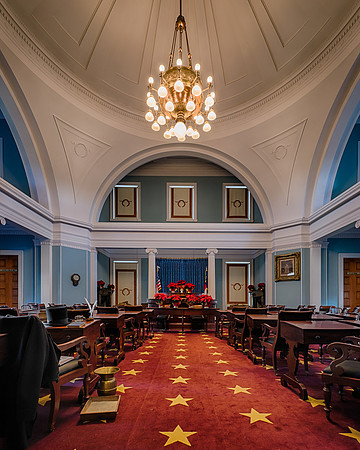 Senate chamberHistoric Senate chamber of the North Carolina State Capitol building at 1 East Edenton Street in Raleigh, North Carolina on December 13, 2014
Shocking Situation #3 - Angel Oak Tree Park
This one takes the cake! I arrived at Angel Oak Tree Park as soon as the gates opened on a Monday in mid-December in hopes of capturing some nice images of this massive oak tree outside of Charleston, South Carolina. Things worked out as planned as I was the only one at the nature park. I immediately got set up and started taking bracketed exposures of the tree. The tree was backlit, so multiple exposures would help extend the dynamic range of the light that the sensor could capture. Also, the scene wasn't very bright, so I was using relatively long exposures to keep my ISO setting low for better image quality--too long for me to handhold the camera.
To my surprise, tripods aren't permitted at the nature park. This was the first time that I have ever experienced a situation where tripods weren't allowed in an outdoor park--a forest! Someone speculated that the reason for the policy is to protect the trees against root damage caused by the impact of the tripod legs. That reason sounds absurd to me. My tripod weighs about three pounds with the weight spread among three legs. I weigh closer to 200 pounds with the weight spread between two legs. If tripods are banned, why aren't people banned?
Fortunately, I didn't learn about the tripod policy at Angel Oak Tree Park until after I was done with my shooting. So, the biggest tripod surprise of the trip wasn't a disappointment at all!
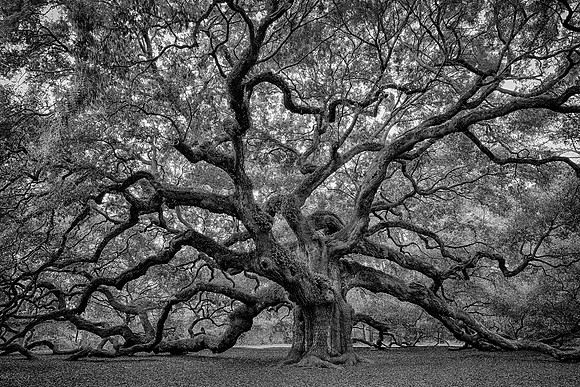 Angel Oak TreeThe Angel Oak Tree is a Southern live oak (Quercus virginiana) located in Angel Oak Park on Johns Island near Charleston, South Carolina on December 8, 2014. The Angel Oak Tree is estimated to be at least 400 and possibly up to 1400 years old. It stands 66.5 feet tall, measures 28 feet in circumference, and produces shade that covers 17,200 square feet. Its longest branch distance is 187 feet in length.