
Focus Stacking - Lions!

Focus stacking is a technique that is sometimes used to extend the depth of field of focus within a frame. By combining multiple images captured at various focus distances, the final image will yield a far greater depth of field than is possible with just one exposure. A common application of this technique is macro photography.
I decided to use this technique on a much smaller scale (i.e., just two images) to extend my depth of field of focus while taking a picture of two lions at the Brookfield Zoo. For this image of the lions, I used my Nikon D800 with the 300 2.8 lens. The lions were positioned back into a relatively dark enclosure of the exhibit which required a longer exposure. At an ISO setting of 400 and an aperture of f/3.5, my shutter speed was just 1/160th. I can get sharp images at 1/160th with the 300mm lens since it is mounted to a tripod.
After taking a shot, I checked the image on my camera's LCD and noticed that the lion was in focus--but the lioness wasn't in focus. At f/3.5 I didn't have enough depth of field to get both lions in focus. I considered using a narrower aperture such as f/11 to extend the depth of field, but that adjustment would take away approximately 4 stops of light. To offset the loss of the 4 stops, I would have to increase my ISO from 400 to 6400 (resulting in a significant loss of image quality) or slow my shutter speed to 1/10th of a second--or go with some combination of the slower shutter speed and higher ISO.
Rather than make those sacrifices, I used a modified focus stacking technique. I locked the camera down on the drop and captured one exposure with the lion in focus. I then captured a second frame with the lioness in focus.
While processing the images, I used the lasso tool to make a loose selection of the head of the lioness from that second frame where the lioness was in sharp focus. I moved that selection onto the first frame (where the lion was in focus). I positioned the in-focus lioness head over the out of focus lioness head in a separate layer. I then applied a white mask to the lioness layer and used a black brush to remove some of the areas around the edge so that only the head of the lioness was replaced with the sharper version. Using this quick and easy approach, I was able to render both lions in focus without having to make destructive in-camera adjustments to my ISO or shutter speed selections.
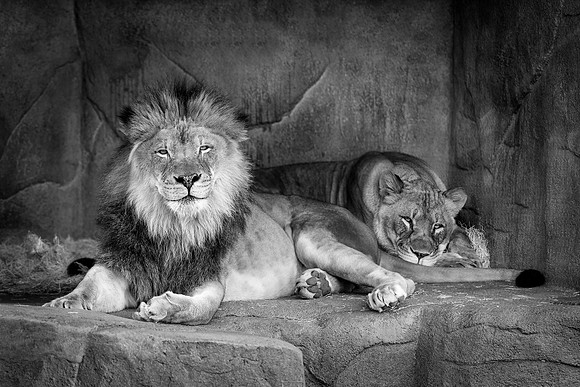 Lions' DenLions at the Brookfield Zoo in Brookfield, Illinois on February 22, 2016
 I wish I had known about this method when I captured this image of a baby gibbon a few years ago. I think the image would have been stronger if the mother was in sharper focus.

The technique of blending more than one image with various focus points is a powerful tool. I've also used it in the past for architecture and landscape images. But, this was my first time using it with lions!