Tripod...Whenever Possible
Whenever possible, I use a tripod while taking photographs. The tripod provides several important benefits:
- Slows me down so that I can carefully consider the composition
- Eliminates camera movement which results in sharper images
- Can shoot at very slow shutter speeds
- Widen the depth of field when needed
- Select lower ISO settings for improved image quality
- More precision with HDR and panoramic images
Given all the benefits, I find myself using a tripod for well over 90% of my photographs! And, the more often that I use the tripod, the more proficient I become at getting it set up quickly and in tight spots! Now, I can set up my tripod and have my camera ready to go in less than 10 seconds!
For a tripod to be useful, it must be stable and able to handle the weight of the gear. My first tripod was a very inexpensive one. I quickly learned that it wasn't preventing camera shake, so I upgraded my tripod. Although the second tripod was better than the first, it was cumbersome and still not very stable. My third tripod was a monster--very stable, but too difficult to carry very far. Finally, I purchased the ideal tripod. Although it was expensive, it will be the last tripod that I should ever have to buy. It's the Gitzo 3540XLS Systematic 6X Carbon Fiber tripod with a Markins M-10 ballhead. The tripod is stable, relatively light and can be adjusted so that it is very low to the ground or very tall (which is convenient given that I'm 6'3" tall). All of my gear is Arca-Swiss compatible, so I can attached lenses or cameras to the tripod within seconds. I also have a L-bracket on my camera to make shooting vertical compositions very easy with the tripod. I wish I would have read Thom Hogan's tripod article earlier as it would have saved me a lot of money and hassle!
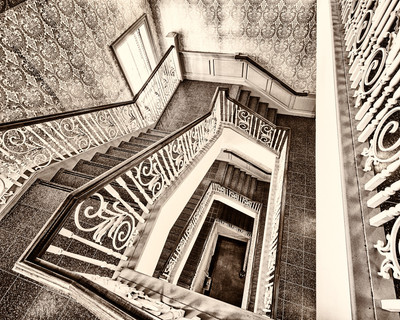
Yesterday, I faced a situation which challenged my ability to position the tripod. I was on the fourth flight of stairs at the Illini Union. The photograph of the staircase from above required that my new D800 camera hang over the railing. At first, I tried handholding the shot. But, I realized that using the tripod would allow me to get enough depth of field and that I could also lower the ISO setting to maximize image quality. So, I adjusted each leg of the tripod to a different height on the stairs to get the camera into proper position.