
Jellies

I recently visited the Shedd Aquarium. I hadn't entered the Shedd Aquarium since I was a kid.
It was the "Jellies" exhibit that prompted me to visit. It's my understanding that this special exhibit will only be in town for the next couple of months, so I made plans to get there in time.
The jellyfish are fascinating to watch. However, capturing good pictures of these creatures isn't very easy! In order to get some decent pictures, I had to overcome these obstacles:
- Of course, the jellyfish are housed behind glass. Typically, I position the lens directly against the surface when shooting through glass to minimize reflections. That conventional approach doesn't work for these jellyfish because the aquariums are very narrow. The jellyfish are usually just inches from the glass--so they are too close if the lens is positioned against the glass. In fact, they were closer than the minimum focusing distance of my Nikon 24-70 lens. Using a macro lens doesn't work either. They are so close that one jellyfish is larger than the frame with my Nikon 105 VR lens.
- The exhibit is dark. For many of the photographs, I had to dial the ISO up to 4,000. Even with that high setting, the aperture was wide open (f/2.8) at relatively slow shutter speeds.
- The creatures are moving. This movement requires a certain minimum shutter speed in order to capture reasonable images.
- No tripods are allowed in the Shedd Aquarium. Although, a tripod wouldn't have helped in this situation as the movement of the jellyfish prevented me from selecting slower shutter speeds.
- Flash photography is prohibited in the Shedd Aquarium.
- The exhibit can be very crowded. Kids think nothing of stepping in front of a photographer. Several times, people banged into my lens as I was looking through the viewfinder to take a picture.
Here's how I tried to deal with the obstacles:
- I positioned myself a foot or two from the glass while shooting. This isn't ideal, but I kept an eye out and minimized reflections. I took care of some minor reflections in Photoshop during post processing.
- The high ISO setting definitely impacts image quality. Fortunately, these pictures don't include a tremendous amount of detail. I used noise reduction in Lightroom during post processing to minimize some of the noise.
- I went with shutter speeds as slow as 1/50th of second during the session.
- I planned my visit during the least crowded time of the year. I visited on a weekday in mid-November and avoided the "free days". For a time, I had the exhibit to myself. Then, I patiently waited for a few field trips to pass through before continuing to shoot.
Here are some of the images. To view the rest, please click here.
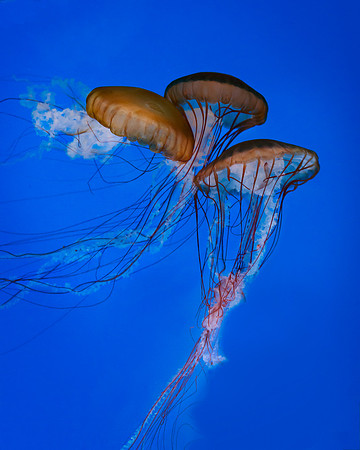 CollisionNortheast Pacific sea nettle (Chrysaora fuscescens) at the Jellies exhibit in the Shedd Aquarium at 1200 S Lake Shore Drive in Chicago, Illinois on November 19, 2014
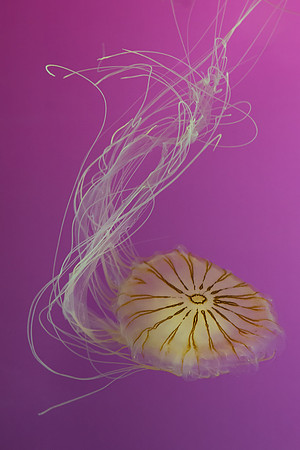 JellyfishJapanese sea nettle (Chrysaora pacifica) in the Jellies exhibit at the Shedd Aquarium at 1200 S Lake Shore Drive in Chicago, Illinois on November 19, 2014
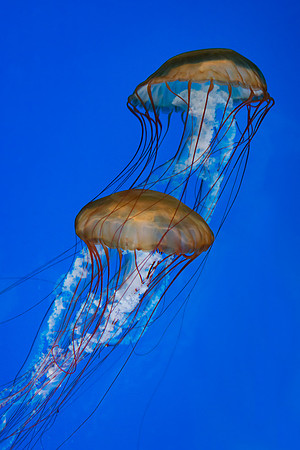 TogetherNortheast Pacific sea nettle (Chrysaora fuscescens) at the Jellies exhibit in the Shedd Aquarium at 1200 S Lake Shore Drive in Chicago, Illinois on November 19, 2014