
Croppability

I doubt if "croppability" is a word--but for photography it should be!
One of the things I like most about my Nikon D800 is its croppability. This advantage comes into play most often when taking photographs of wildlife. I think this image of a Golden Weaver helps illustrate this advantage.
Here's the out of camera (OOC) image from the D800. It's not cropped at all, so the dimension of this file is 4,912 pixels wide by 7,360 pixels high (or 36 megapixels):
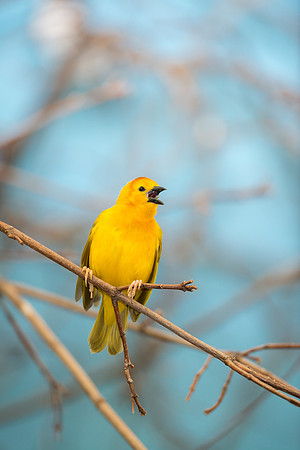 Golden WeaverTaveta Golden Weaver (Ploceus castaneiceps) at the Brookfield Zoo in Brookfield, Illinois on September 4, 2014
In my opinion, this image is much stronger when cropped. The cropped version guides the viewer's eye to the subject of my photograph in the most basic way possible--by making the subject larger within the frame.
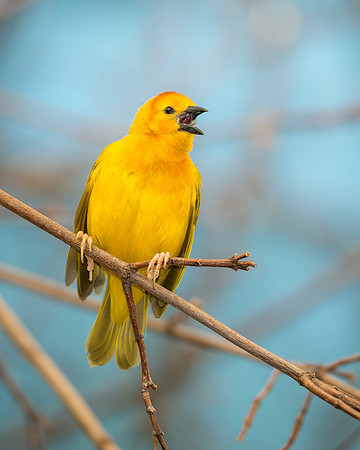 Golden WeaverTaveta Golden Weaver (Ploceus castaneiceps) at the Brookfield Zoo in Brookfield, Illinois on September 4, 2014
This is a significant crop, yet the remaining file is still quite large. The cropped version measures 3,772 pixels wide by 4,715 high (or 18 megapixels). As a perspective, if I had captured this same picture with my Nikon D700 the original file before cropping would have been only 12 megapixels!
This photograph was captured with a 500mm f/4 lens. I left the aperture wide open at f/4 and selected a very slow shutter speed of 1/40th of a second. The ISO was 800. As a perspective, if I had stopped down to f/5.6 and gone with a reasonable shutter speed of 1/320th of a second, the ISO would have increased to an astronomical 12,800 to achieve the same exposure. At that ISO level, my post processing treatment would have been to just delete the image from the card!
Croppability helps to keep the ISO down. If I had instead elected to use my Nikon 1.4x teleconverter to achieve more reach, my ISO would have been 1,600 to achieve the same exposure (due to the narrower aperture required). Not only does the higher ISO setting negatively impact image quality, but so does the addition of another piece of glass (the teleconverter). Also, my depth of field becomes wider with a narrower aperture--which diminishes my creative intention of blurring the very distracting branches behind the bird.
While many people tend to mention how the larger files make it possible to create bigger prints, I think the advantages of "croppability" extend far beyond that.