|
I'll be posting some random thoughts here about my photography: my travel plans, technical information behind some images, stories about how certain pictures were captured, etc. The timing of the postings will also be random as my priority is capturing new images rather than writing about existing ones. I hope you will feel free to comment on any of my postings and I appreciate you taking time to read my entries.

Mopping the FloorMost of the time, I look for reflections in the water. However, reflections can also be found on glass windows as well as wet or shiny surfaces. The floor of the Tennessee State Capitol building provided such a surface--and an opportunity to create an interesting symmetrical photograph. When composing such an image, it's important to view the scene from various perspectives. In this case, I ended up positioning the camera very close to the floor to ensure that as much of the reflection is included in the frame as possible. Another aspect to consider is the high dynamic range included in this scene. Obviously, the chandeliers are very bright while other sections of the corridor are quite dark. To retain details in the highlights and shadows, I captured seven exposures (one stop apart) and blended them during post processing to create a HDR (high dynamic range) image. I enjoy taking pictures of corridors with vanishing points. While I would have photographed this corridor without the reflection, I think the shiny floor and the strong reflection improves this photograph significantly. I'm glad they mopped the floor before I arrived!
Nikon D700 with Accessories for SaleI've decided to part with my Nikon D700 and some of its accessories. Since purchasing the Nikon D800 more than three years ago, the D700 has served as my back-up camera and simply isn't seeing enough use. The camera is in perfect operating condition. It is also in excellent cosmetic condition--although does have a minor scratch on the pop up flash cover. The camera has 70,500 shutter clicks. In addition to the camera body, I'm including the following two items (which sell for nearly $400 if new):
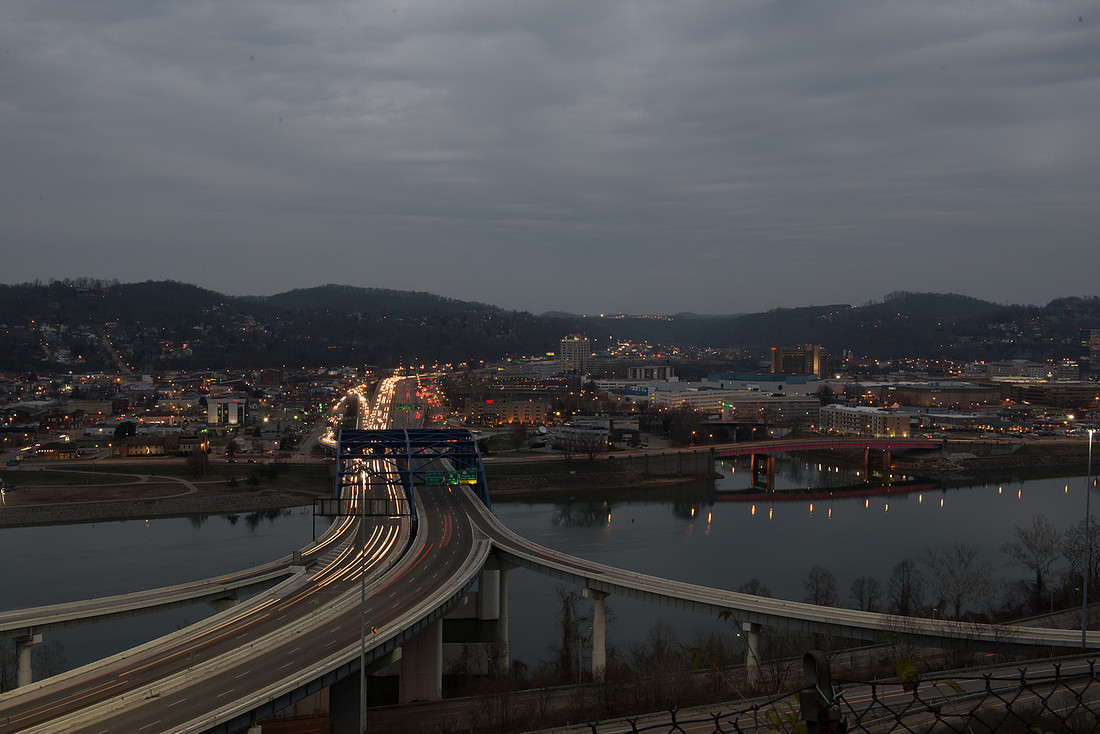
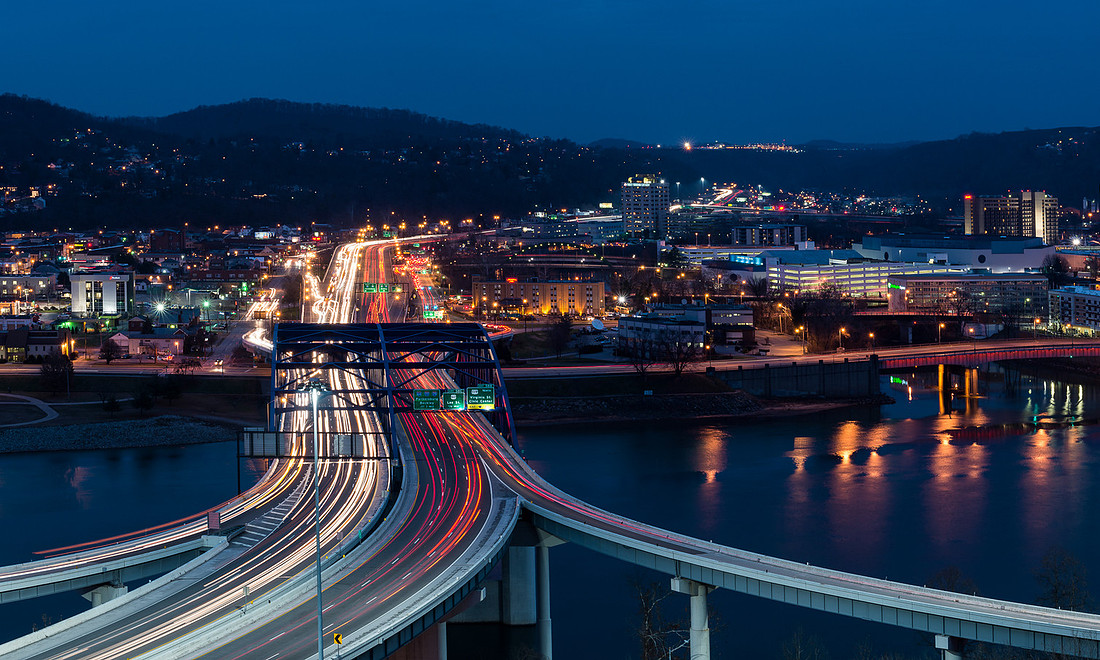
The camera ships in its original gold box and comes with its unused D700 strap and manuals. This is one of Nikon's legendary cameras and is super fast with included vertical grip. The last time I used the camera was on May 1st for a tennis photo shoot. Click here to view those action shots. I'm asking $1,100 for the camera, vertical grip and L-bracket. This includes PayPal fees and shipping within the continental United States. Please contact me at [email protected] or at 708-846-1466 (cell) with any questions. Glenn Nagel The Blue HourThe "blue hour" is one of my favorite times to take photographs. Wikipedia defines the blue hour as: "The blue hour is the period of twilight each morning and evening when the sun is a significant distance below the horizon and the residual, indirect sunlight takes on a predominantly blue hue. This effect is caused by the relative diffusability of short blue wavelengths of light versus the longer red wavelengths. During the blue "hour" (typically the period is about 40 minutes in length), red light passes straight into space while blue light is scattered in the atmosphere and therefore reaches the earth's surface. Because of the quality of the light, this period is treasured by artists. Photographers call it sweet light." Here's an example of how the blue hour impacts a photograph. This was my last photo shoot from my recent trip through the Capital Cities of the Southeast. Sunset was 4:08 PM in Charleston, West Virginia. With all of the cloud cover, there wasn't much of a sunset to photograph. At 4:16 PM, the sky was still gray. I was beginning to doubt whether any colors would appear at all that night:
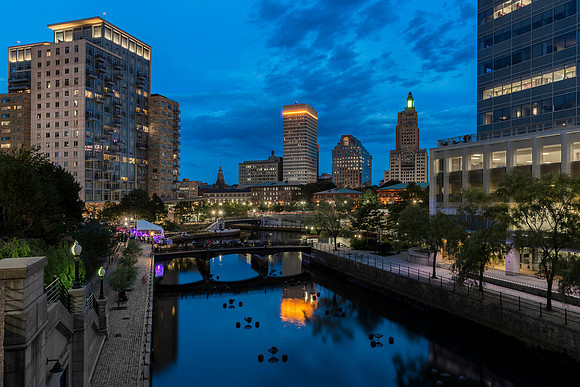
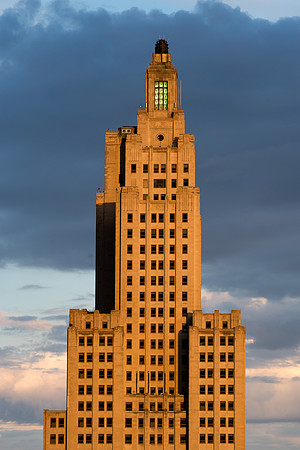
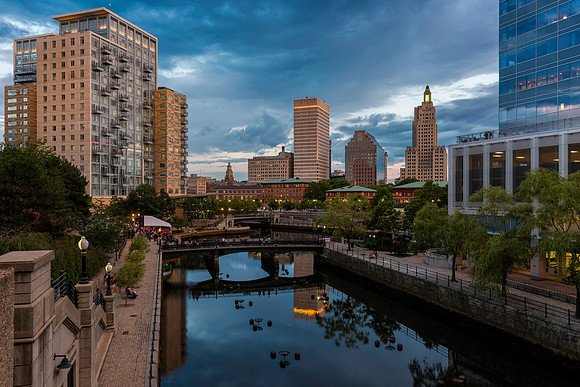
Finally, here's a recent one from Providence, Rhode Island:
96% Holy TrinityAfter returning from a photography trip, I like to analyze how often I use each lens. During my last trip through the Capital Cities of the Northeast, I used wider focal lengths more often due to the high percentage of architectural subjects. On a typical day, the following lenses were placed in my backpack: (1) Nikon 14-24; (2) Nikon 24-70; (3) Nikon 70-200 VRII; (4) Nikon 105 VR; and (5) Sigma 15mm Fisheye. The first three lenses are often referred to as the "Holy Trinity". That trio of lenses covers the focal lengths from wide to narrow (14mm through 200mm). All three lenses are fast (f/2.8) and sharp. During the road trip, I considered 492 images to be keepers. Those are the images that I processed. Of the 492 pictures, all but 25 were captured with one of the Holy Trinity lenses. The Holy Trinity of lenses accounted for 96% of all of my photographs!
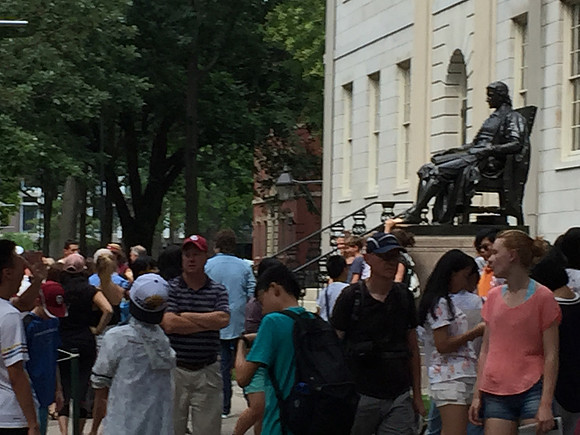
Photography, or the Lack Thereof, at HarvardDuring my recent road trip through the Capital Cities of the Northeast, I stopped in Boston for a few days. While in Boston, I rode the "T" subway to Cambridge to see a couple of college campuses: Harvard University and the Massachusetts Institute of Technology (MIT). A friend of mine graduated from Harvard and provided me with several recommendations of things to photograph on the campus. But taking pictures on the Harvard campus was not an easy task. For one thing, I've never experienced such severe access restrictions before. Months before my campus visit, I requested permission to take pictures inside the Widener Library. The response was that photography is not permitted inside the library--even without a tripod. Furthermore, photography of any kind is prohibited in any building on the Harvard campus. I was also told that tripods are not permitted anywhere on the campus--not even outside while shooting the exterior of buildings. When I arrived on campus, I found the restrictions to be even more severe than that. As I approached the security screening station inside the Widener Library, I was told that not only couldn't I take pictures inside the building, but that I wasn't allowed to enter the building even without a camera. This held true for all of the buildings that I approached--including Memorial Church and Sever Hall. Even as part of one of the guided tours, we were not permitted to enter any of the buildings--which greatly diminished the tour experience. That being said (or written), I could easily understand why Harvard University needs to put these restrictions in place. Before long, the University won't allow visitors to step foot on campus. Part of the reason is that the campus was just packed with tourists. It was so crowded that it literally reminded me of how the crowds were the last time I visited Disneyland. One of the pictures I attempted to capture was an image of the statue of John Harvard in the Harvard Yard. This was a frustrating experience as there was a very large crowd waiting to take pictures of the statue. The approach I took to get one quick picture was to have my brother stand next to the statue for a second to clear the crowd--then he backed away for the scene to clear.
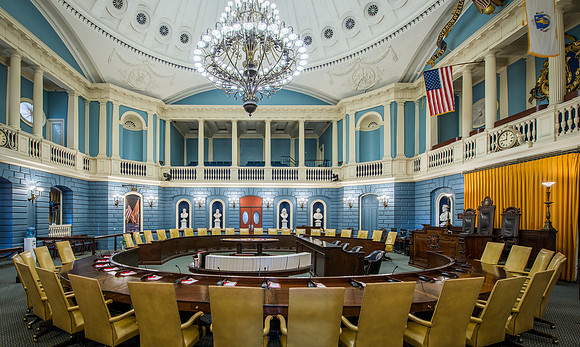
I thought that maybe I just happened to visit on an unusually crowded July day, so I returned the next day. It was just as crowded during my second try. MIT, on the other hand, wasn't nearly as crowded. And, all of the buildings were open and accessible for photography. To view my images from these campuses, please CLICK HERE. The Longest YardWhen photographing the State Capitols, I always try to capture images of the House of Representatives and Senate chambers. While in the chambers, I usually take the conventional symmetrical shot of the room from the center aisle. During my visit to the Massachusetts State House, I was pleased to see that the chambers were open and lit. It's more difficult to capture those images when the chambers are locked and accessible only through the guided tour. Better yet, I was the only one in the chamber. In fact, I was probably the only visitor in the entire building at that time. So, I set my tripod up and took the following image for starters:
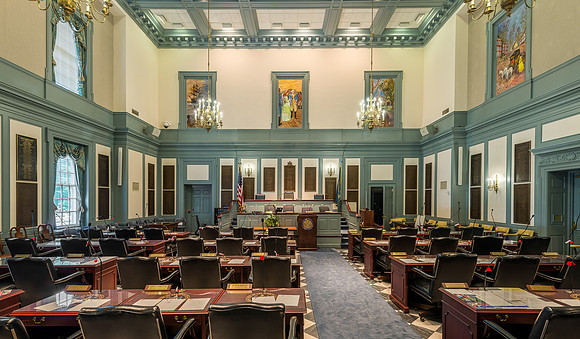
In this Senate chamber, there was a security guard standing to my right. At first, he warned me about the tripod. He pointed out that someone might trip over one of the tripod legs. I replied that I shoot with a tripod all the time and that I would immediately move the tripod if anyone entered the chamber. After I captured a few images from the side, I tried moving to the back center of the room to get the more conventional perspective. The problem was that I couldn't quite get positioned there. There was a rope hanging between two temporary stands about three feet from where I needed to be. In nearly every capitol that I visit, I simply unhook the rope, move into position to get the shot, and then hook the rope back into position. Since the security guard was in the room with me, I thought it would be good to ask. So, I asked him if it would be possible for me to move over three feet for a few seconds to grab that one picture. He said that messing with the rope would not be possible. And that was the end of the story! It's always a little frustrating when things like this happen after driving 1,100 miles to get to a site. Photo Needs More Republicans!One of my recent State Capitol photographs would benefit from having more Republicans in office. And, this has nothing to do with politics! While visiting the Delaware State Capitol, or Legislative Hall in Dover, it was nearly impossible to achieve symmetry while creating the chamber shots. Take a look at how off balance the House of Representatives chamber looks from the center aisle:
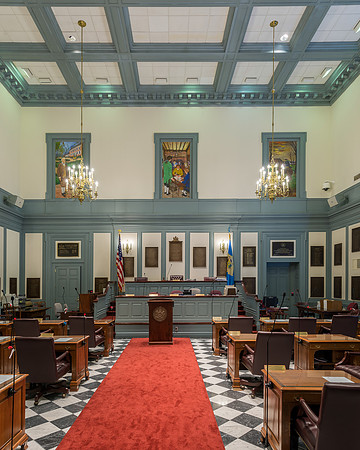
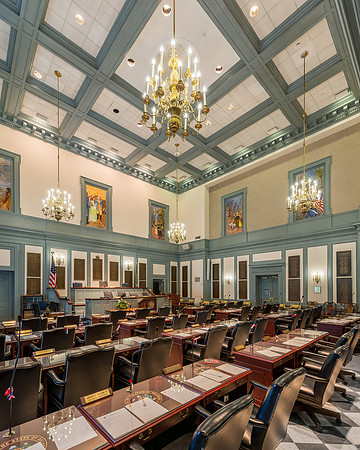
I experience a similar issue in the Senate chamber. 12 of Delaware's 21 state Senators are Democrats. So, my picture of the Senate chamber also lacks symmetry:
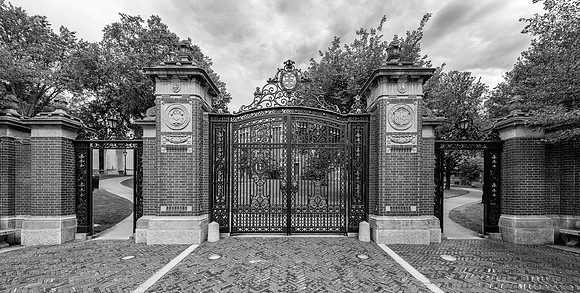
Flip the SwitchYesterday, I posted a blog entry about the problems I was having with an unresponsive vertical battery grip (the Nikon MB-D12). It was clear that the grip was properly connected because the camera indicated that full power was coming from the grip. Yet, the rest of the controls (i.e., shutter button, auto-focus button and switch) weren't working. So, I drove to APS (Authorized Photo Service) in Morton Grove, Illinois. After explaining the issue, the first APS employee I met said that I would need to leave both the camera (Nikon D800) and the grip so that a technician could determine which item was causing the problem. I suggested that we take the grip and attach it to a working D800 to help isolate whether the problem related to the grip. I didn't like the idea of leaving my camera again after just getting it back from Nikon's service center in Melville a couple of days ago. Next, a technician was called to the counter so that I could explain the problem to a more experienced person. I handed the camera with grip to the technician. He briefly touched the grip, handed the camera back to me and said that the problem was fixed! Sensing my confusion, he told me that there is a small lock switch right next to the shutter button on the grip. He simply moved it out of the locked position. Apparently, when it's locked the shutter and other controls cannot be activated. My Google searches relating to how to fix a grip that isn't responding didn't yield such a solution. I've been using the grip for more than three years and never knew that the grip had a lock switch! I must have accidentally knocked it into the locked position at some point during my last day of shooting on my road trip through the Capital Cities of the Northeast. I doubt that this lock feature is something that I'll ever willingly use. My camera and grip are now working perfectly. Learning that the solution was so simple was somewhat embarrassing. On the other hand, the good news is that the grip didn't require a repair! Next Up, the Vertical GripIn a recent blog entry, I wrote about some issues with my gear. Yesterday, I received my Nikon D800 back from Nikon's service center in Melville. True to its word, Nikon provided free maintenance (and shipping back and forth) for my D800 despite the fact that my camera is more than three years old now. The invoice (with a total cost of zero) indicated that Nikon checked the auto-focus operation, checked exposure accuracy, updated firmware, cleaned the sensor, and performed a general check and cleaning. In addition to my camera, I experienced issues with three other pieces of gear during my recent road trip through the Capital Cities of the Northeast! Another component that caused some problems was my Really Right Stuff (RRS) BH-55 ballhead. More specifically, the quick release clamp was sticking. At first, it was rather alarming. I was taking pictures of the Van Wickle gates at Brown University when I decided to flip my camera into the vertical position for a few more shots. The camera would not release from the clamp--so it was stuck to the tripod! Although I could flip the lever open easily enough, the clamp itself was not responding. Fortunately, RRS has excellent customer service. I called RRS right then. The representative explained that I should shift the camera back and forth with some force to pry it loose from the clamp. I was able to eventually remove the camera from the tripod. The representative also referenced this helpful video from the RRS website regarding this issue. After I returned home, I followed the video's instructions and the ballhead seems to be working properly now. So, two down...two to go. The next issue I had was with my camera's MB-D12 vertical battery grip. I find the vertical grip to be an important tool for my photography. It looks like this:
As a side note, the vertical grip works great with a L-bracket. The L-bracket looks like this:
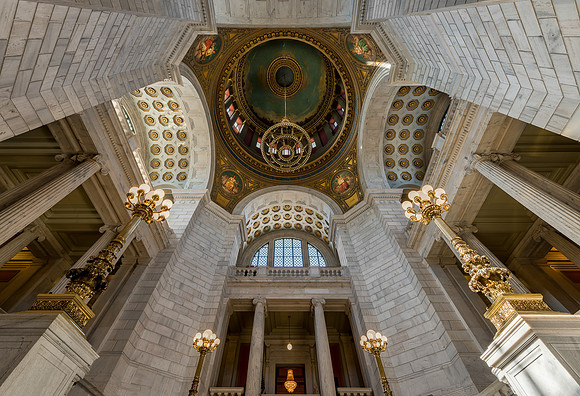
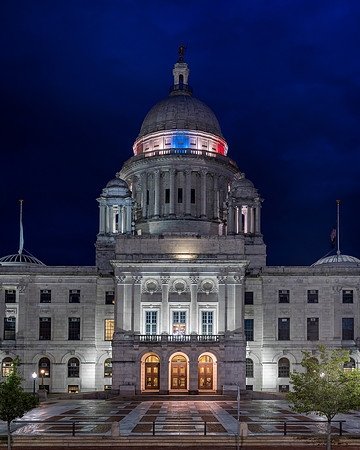
The fourth item which caused issues for me during the trip is my Gitzo tripod. The legs now require more force to tighten. If I don't take extra care to tighten the legs enough, the legs slowly slip down while I'm shooting. I called Gitzo and was told that this issue is common after a tripod has been used extensively for years. The bearings begin to wear down. The more surprising thing is that the estimate for this maintenance is about $350. So, I'm just taking more care during tightening at this point. But, before long I'll need to deal with the issue. Edit: I forgot to mention that the zipper on my Think Tank Airport Acceleration v2 backpack also failed recently! Think Tank told me that the zipper tends to fail after five years or so when used extensively. Fortunately, a local shoe repair store repaired the zipper for a relatively low cost. The Longest DayJune 24, 2015 was the longest (and most productive) day that I've ever had for photography. In the end I processed and kept more than 150 pictures from that day. More than 65 images have been accepted into stock agency portfolios so far from that one day of shooting. I started shooting at 7:45 am and made my last shutter click at 9:15 pm--and walked more than 12 miles with a pack on my back. It started with an early breakfast at the Hampton Inn in Warwick, Rhode Island. I then drove into Providence in time to enter the Rhode Island State House as soon as it opened. I spent a couple of hours taking pictures of the interior of the State Capitol building before taking the guided tour of the building.
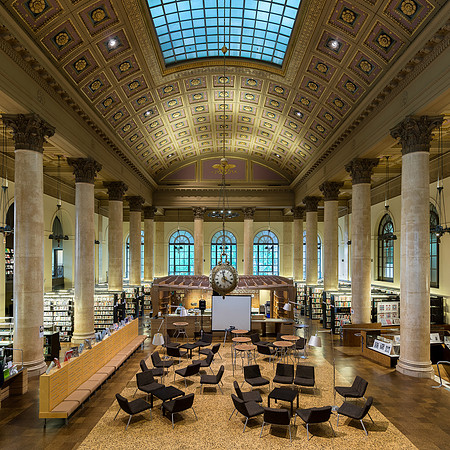
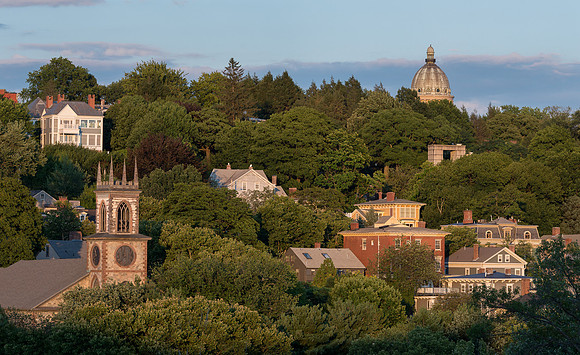
My next stop was City Hall. Providence City Hall is an impressive building. I spent a couple of hours taking photographs of the interior--and climbed countless steps during that visit. During my photo shoot, I was approached by a long-time employee who works in the city's archival department. He was incredibly cooperative and opened the City Council chambers so that I could capture pictures inside that room as well.
The light was exceptional--here's one looking into the hills of Providence in the direction of Brown University:
|