|
I'll be posting some random thoughts here about my photography: my travel plans, technical information behind some images, stories about how certain pictures were captured, etc. The timing of the postings will also be random as my priority is capturing new images rather than writing about existing ones. I hope you will feel free to comment on any of my postings and I appreciate you taking time to read my entries.

Correcting "Popeye's" SkinNot too long ago, I was looking at some of my favorite "People" pictures. Don "Popeye" Zimmer was the subject of one of those pictures. I captured this portrait at Tropicana Field in St. Petersburg back in 2008. Tropicana Field is an indoor venue, so the lighting is artificial. Looking at the picture now, Zimmer's skin tone looks far too yellow. Back in 2008, I didn't have any understanding of the tools at my disposal to analyze and correct skin tones. Since Photoshop provides an objective way of measuring the skin tone, I thought this process would make for an interesting post! Here is the photo is question:
Next, convert the RGB values inside of the Info palette to CMYK percentages by clicking on the little eyedropper on the left side of the readings. The readings should for the selected sample should now appear as CMYK percentage values. For this control point, the cyan reading is 11%, the magenta reading is 48% and the Yellow reading is 74%:
Before proceeding, I refer to a few guidelines for reading an average caucasian's skin tone:
In the above photograph, the yellow value is too high as compared to the magenta reading. So, my instinct is correct--the skin is too yellow! My next step is to make some adjustments to the color curves to correct the skin tones. Before getting started with those adjustments, I create a Curves adjustment layer. I then select the Blue channel within the Curve. Then, I select the portion of the curve that represents my first control point and drag the curve up (more blue, less yellow) until the yellow reading drops closer to the magenta reading:
Next, I make an adjustment to the same portion of the curve, but this time I open the Red channel and drag it down (less red, more cyan) until the cyan reading reaches about half of the magenta value. At this point, the cyan is just under half of the magenta value. And, the yellow value is 20% (1/5th) higher than the magenta value. Based upon these relationships, we know that Zimmer's color is now typical for a caucasian skin.
The skin color now looks accurate to me--and far better than in the original image. And, the numbers bear that out. If you are not yet satisfied, you can always drop more Color Sampler points on different portions of the skin and use the same method for correcting each area. Also, if you don't like what's happening to the color of the background, feel free to mask it off in the layer.
I've used this method quite often when skin tones need correcting. Once you get the hang of it, you can accomplish the steps quite quickly. Early Arriving CrowdWhile visiting Acadia National Park in Maine, I planned to photograph the sunrise from the peak of Cadillac Mountain. During most times of the year, Cadillac Mountain is the first location in the United States to be touched by light from the rising sun. When I photograph sunrises, I like to get to the location at least 30 minutes before sunrise. This gives me time to set up, and I usually prefer the quality of light before the sun actually rises. Another thing I try to do is to scout the location in advance. The day before my photo shoot, I drove to the top of the mountain and selected my vantage point. The classic photograph from Cadillac Mountain includes slabs of granite in the foreground with the bay and islands in the background. To reach the top of the mountain in time, one needs to leave very early in the morning. Sunrise was at 5:07 am, so I left the campground at 4:15 am--and that was cutting it close. To my surprise, the traffic became congested as I approached the road that leads to the summit! A caravan of cars, nearly bumper to bumper, worked their way up the winding mountain road. When I arrived at the summit's parking lot, there were only a few open spaces left. Before long, the lot was filled and people were parking along the road. To my disappointment, there were so many people at the summit that I couldn't set up my tripod on the spot I selected during my scouting. There were hundreds of people scattered around the summit by 4:45 am! My conservative estimate is that at least 500 people were there, but I wouldn't be surprised if the number was closer to 1,000 people. It amazed me that there were so many people out and about at 4:45 am, including numerous families with small children. This is not the type of experience that we envision as landscape photographers. I moved forward to a new vantage point that eliminated all of the tourists from the frame. Unfortunately, that meant sacrificing the granite foreground. But, I was still pleased with this image that I titled "First Light":
Later that morning, I was taking pictures in the nearby town of Bar Harbor when a couple of people approached to ask me if I had been on the summit for sunrise. They shared the following picture with me--a rare photograph where I'm the subject! This is an image of me moving from the spot that I scouted the previous day to the area where I captured the "First Light" photograph displayed above:
"A Look Through My Lens" Published for 2015Each year, I create a book featuring my favorite images from the year. More than 150 photographs are included in this 160 page book for 2015. You may CLICK HERE to view a full preview of this year's book. It's most effective to view the images with pages of the book expanded to fill your monitor. I use Blurb to create my books. I'm very pleased with the quality of the product--from the binding and paper to the image quality. Producing such a small quantity of books makes the per unit cost very high. I make these available for purchase at the base cost from Blurb. Often times, promo codes are available through a Google search to lower the cost by 15 to 25%. I used the promo code TIME25 for a 25% discount. This is the eighth annual "A Look Through My Lens" book that I've created. I always wonder if I'll capture enough decent photographs in the upcoming year to keep this streak alive! I think my next books will center on State Capitols and Places of Worship. "Bass Harbor Lighthouse" Wins Photo of the DayThis morning, my "Bass Harbor Lighthouse" picture won Imaging Resource's "Photo of the Day". CLICK HERE to view Imaging Resource's Photo of the Day page. This photo was captured in August during my road trip through the Capital Cities of the Northeast.
This marks the 29th time that one of my photographs was recognized by Imaging Resource as its "Photo of the Day". Click here to view the other 28 winning entries over the past three years.
This Facebook Ad Caught My Attention!This morning, I was reading through my Facebook news feed when I noticed an advertisement from Shutterstock--a photo stock agency. The advertisement caught my attention because the picture that's featured is one of mine! I submitted this photo to Shutterstock a couple of years ago and it has been selling at a nice pace ever since. It's from the Castillo de San Marcos National Monument in St. Augustine, Florida.
500mm Comes in HandyMany photographers invest in one of the big super-telephoto lenses in order to capture photographs of birds and other small animals. Although I use my Nikon 500VR lens to photograph birds on occasion, I tend to use it more for the following purposes:
EVENTS: My 500VR lens got a workout at the reenactment activities commemorating the 150th anniversary of the Civil War battles at Gettysburg. The lens enabled me to get a closer view of the action. It compressed the battlefield--helping to make the scene appear more congested. Finally, the narrow field of view helped to keep unwanted elements (e.g., spectators, cars, etc.) out of the frame.
The 500VR helps to simplify and compress landscape images. The narrow field of view also enables me to select just a small portion of the landscape to feature in the photograph.
The 500VR lens lets me fill the frame when photographing larger animals at the zoo. The extended reach of the lens means that little or no cropping of the frame is required during post processing, which yields higher image quality.
And, let's not forget the birds. It's a great lens for photographing birds.
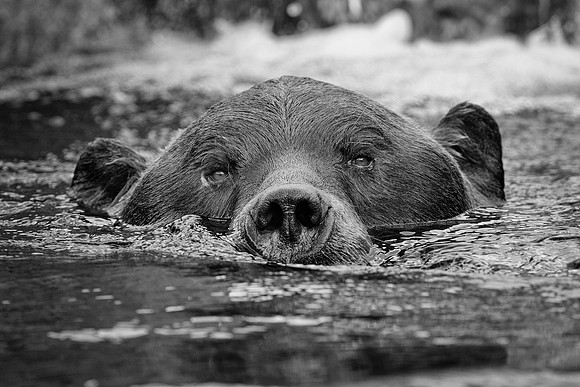
Personally, I think it makes it easier to create more interesting photographs when shooting at the extremes of the focal length scale. I find myself shooting at either the 14mm (my widest lens) or the 500mm (my narrowest lens) focal length for a high percentage of my shots. The "Cycle" TrickI photograph animals at the Brookfield Zoo quite often. Most people think that photographing animals in captivity must be easy. After all, the exhibits are small enough that the animals are practically forced into a position that is right in front of the camera. While it's obviously much easier than capturing images of animals in the wild, zoo photography still requires a lot of patience. While taking photographs at the zoo, my approach is to watch an animal's behavior for a while--sometimes up to 30 or 40 minutes. If an animal is sleeping, I usually visit another exhibit and return later. If an animal is exhibiting an interesting behavior, it will usually cycle through those behaviors repeatedly. This makes it more likely to capture an action at a peak moment. For example, I noticed how this Alaskan brown bear would dive into the small pool of water, then swim to the other side, get out of the water, walk around the perimeter of the large exhibit, and then dive back into the pool of water--starting the cycle all over again. During the first cycle, I was observing and didn't capture any pictures. I was more prepared for the second round, but missed on the timing of these challenging shots. The third time was a charm:
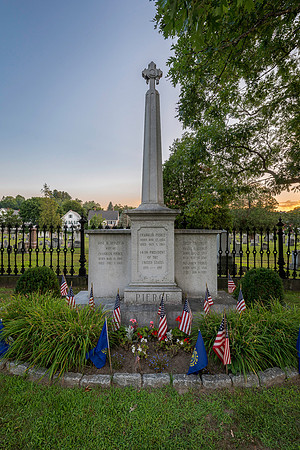
There was no fourth time. But, if I had stayed for another 45 minutes, I bet that the bear would have repeated the cycle again! South Dakota ItineraryMy next photography trip is to the Black Hills of South Dakota! Following is my preliminary itinerary: Day 1- Sioux City, IA Day 2- Sioux Falls, SD: St. Joseph Cathedral, Falls Park, Zoo Day 3- Wall, SD: Badlands National Park Day 4- Wall, SD: Badlands National Park Day 5- Wall, SD: Badlands National Park Day 6- Custer, SD: Custer State Park Day 7- Custer, SD: Wind Cave National Park Day 8- Deadwood, SD: Mt Rushmore, Crazy Horse Memorial Day 9- Rapid City, SD: Bear Butte, Chapel in the Hills Day 10- Des Moines, IA Day 11- Orland Park, IL This 11 day trip will cover approximately 2,300 miles. I won't be leaving for about a month, so hopefully the weather will hold up. Franklin Pierce's TombDuring my road trip through the Capital Cities of the Northeast, I visited the Old North Cemetery in Concord, New Hampshire. Franklin Pierce, the 14th President of the United States, is buried in this cemetery. So, on my way back to the hotel after dinner, I stopped to see the tomb. I arrived at the cemetery at dusk. I had difficulty finding the tomb. There aren't any signs pointing the way. I wanted to find the tombstone before dark so that I could capture a few photographs. Fortunately, a man was walking his dog through the cemetery and was able to help me find it. The burial site is surprisingly unassuming for a President of the United States. Only the small flags in front of the tombstone give any indication that a person of historic significance is buried here. There are many other tombstones in the vicinity that are at least as large as this one. The low key treatment might in part be due to the general consensus that Franklin Pierce was one of the nation's least effective Presidents. Pierce suffered his share of tragedies. All three of his sons died in childhood. The first died in infancy and the second of disease at age four. A few weeks after his election to the Presidency, the family was riding on a train that crashed. Pierce and his wife survived the accident, but Pierce's eleven year old son died in the crash. Pierce, his wife and two sons are all buried at this site.
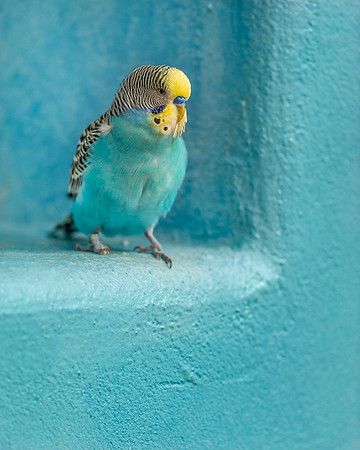
Sometimes It's All About ColorIt had been a while since I visited the Brookfield Zoo. Since my last visit, the Zoo opened a new exhibit--the Hamill Family Wild Encounters. One of the attractions within the space is a free fly area for hundreds of parakeets. The parakeets are a challenging subject to photograph. They are quite small at about 6 inches tall. They are also fast and fidgety. And, they are housed in an indoor exhibit where light levels aren't the brightest. I noticed that one of the side walls is painted in a color that nearly matches that of some of the parakeets. So, I focused my lens on a ledge and waited for a parakeet of the right color to land. Sometimes, the ledge was busy with several parakeets at once. Other times, the parakeet was facing away from the lens. After waiting for a while, a parakeet of a matching color assumed the pose that I was looking for.
|