|
I'll be posting some random thoughts here about my photography: my travel plans, technical information behind some images, stories about how certain pictures were captured, etc. The timing of the postings will also be random as my priority is capturing new images rather than writing about existing ones. I hope you will feel free to comment on any of my postings and I appreciate you taking time to read my entries.

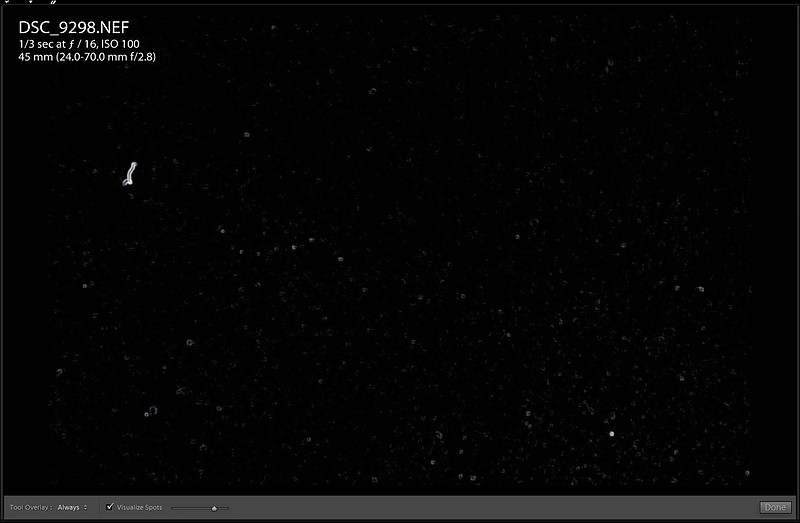
Sensor Gel Part IIA few months ago, I posted an entry about my experience with a new sensor cleaning product called Sensor Gel. Click here to view that post. After returning from another photo road trip with countless lens changes, I again reached for the Sensor Gel to clean the sensor of my Nikon D800. Once again, I am pleased with the results. Before:
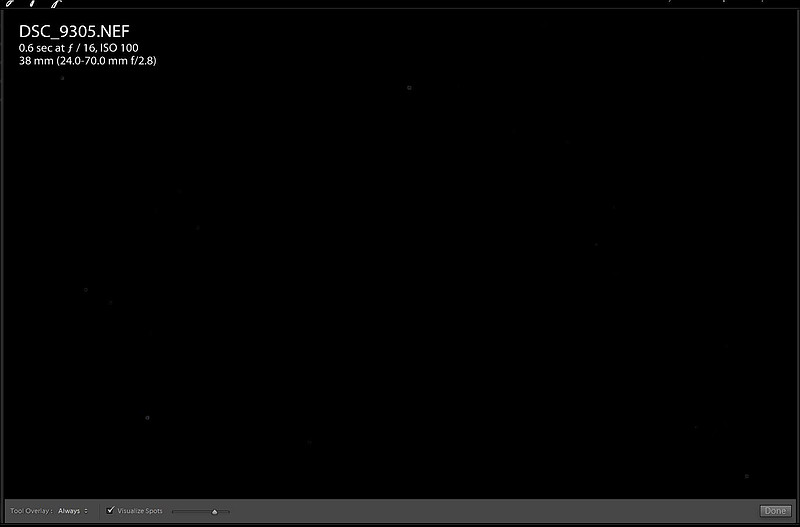
And after:
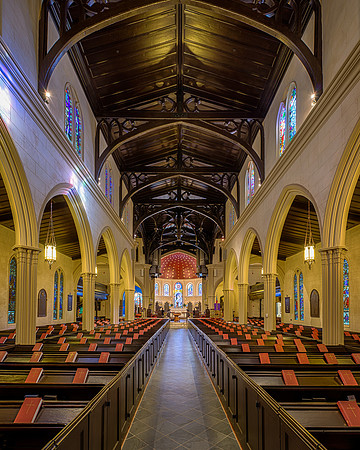
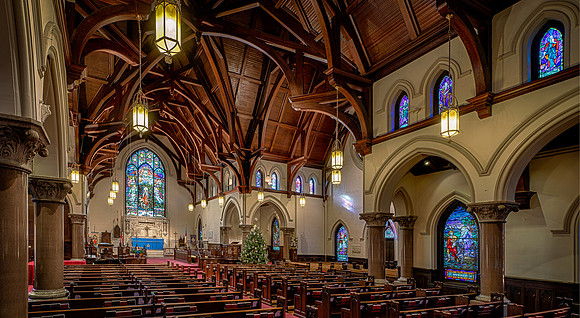
There are still a couple of faint sensor spots visible after the cleaning. While the sensor isn't perfectly clean, it's certainly acceptable--particularly given that I'm testing the cleanliness at f/16 and with a low tolerance setting on Lightroom's "Visualize Spots" tool. Sometimes it pays to know when to stop cleaning the sensor. Further cleanings might make matters worse. If nothing else, the Sensor Gel has postponed the time when I'll need to take the camera into APS for a more thorough, professional cleaning. That's well worth the cost of this product in my opinion. Everybody Wins!During my last road trip through the Capital Cities of the Southeast, I photographed ten churches. The people in most of these ten churches were amazingly cooperative. Only one church (the Trinity Episcopal Cathedral in Columbia, SC), presented a challenge. The Challenging Church While visiting the South Carolina State Capitol, I decided to take a look inside Trinity Episcopal--which is located across the street from the Capitol. Fortunately, the front door to the church was open. I was immediately impressed with the beauty of the interior of the church. Unfortunately, the church was dark and I was unable to find the lights (which ultimately was a good thing). I began searching the rather large church campus for someone who might be able to help me. After several minutes, I finally met a custodian. He had no idea if photography was permitted and wasn't about to help with the lights unless the pastor granted permission. Before very long, the pastor approached the building from the parking lot. Usually, when I ask to photograph a church, the pastor or priest quickly grants permission. In this case, it was clear that the pastor was very uncomfortable with my request. He also mentioned to me that the entrance to the church was intended to be locked. I explained to him that I photograph churches from all over the country. I've photographed well over 100 places of worship without issue. I handed him my business card so that he had my contact information. Surprisingly, he continued to look at me with a lot of uncertainty. I asked him what his concerns were about my photography. He replied that a couple of years ago a photographer captured images of the interior of the church--and later sold some of the pictures. I have no idea why this would cause so much concern, but I asked if it would help if I promised not to sell any of my pictures. I also told him that I always offer my pictures to the church for free--and that the church may use the images in any way they see fit (website, programs, etc.). At that point, he agreed to let me take pictures inside the church for as long as I wanted. And, he made sure that every light in the church was on!
Nearly every church that I visit is cooperative when it comes to my photography. Two of the churches from this last trip went above and beyond. Atlanta's Oldest Church The oldest church, and the second oldest building in downtown Atlanta is the Catholic Shrine to the Immaculate Conception. The church was saved from destruction during the Civil War when Father O'Reilly appealed to General Sherman to spare the church during the burning of Atlanta. This church was locked when I arrived. However, there were several homeless people being fed in the basement of the church. I entered the basement and asked if it would be possible to photograph the church's interior. My request was met with enthusiasm--and I was granted permission to photograph the church for as long as I wanted...and all the lights were turned on. As I was leaving, they asked if there was anything else that they could do for me. I said I would like them to direct my cash donation to meals for the homeless. In the end, I had a fantastic experience and the church received a donation and free photographs. Everybody won!
All of the historic Churches of Raleigh were amazingly cooperative. It's hard to say which of the five churches that I photographed was the most enjoyable to visit, but my experience at the Church of the Good Shepherd was unique. The receptionist was eager to share information about the history of the church--particularly about the many stained glass windows. About 45 minutes into my photo shoot, she approached me and said that I obviously had a great appreciation of the church's architecture--so she presented me with a gift! It was a coffee table book titled "A Vision Realized: Stories in Stained Glass of the Episcopal Church of the Good Shepherd". As she handed me the book, she said "Merry Christmas"! As was the case in Atlanta, I felt that a cash donation to the church was very appropriate here. And, I was pleased to see that this church was also doing the hard work of feeding many homeless people. So, this donation was also earmarked for that very worthy project. Once again, everybody won!
Hoping for Rush Hour Traffic!Last month, I stopped in Atlanta for a day to photograph the Georgia State Capitol. Later that day I searched for a good vantage point to capture an image of the city. A helpful employee in the Atlanta Visitor Center mentioned that he sometimes sees photographers positioned on the Jackson Street overpass. I drove over there and liked what I saw. I parked by the bridge about 20 minutes before sunset. There was already one photographer set up at the location. When I started to initiate a conversation with him, it was quickly apparent that he could speak very little English. He was visiting Atlanta from Brazil. I speak no Portuguese. By flashing his fingers, he was trying to ask me how long it would be before the light would be good for pictures. He also indicated that his goal was to capture the traffic streaks of the cars by moving his hand in a sweeping motion across the highway. He would flash both hands at once to indicate ten minutes. Two times meant 20 minutes. I opened and closed both hands four times to indicate 40 minutes. While it was only 20 minutes until sunset, the light gets much better several minutes after that. Once the sun goes down, the sky darkens further which reduces the dynamic range of light in the frame. This reduced contrast helps boost the colors. There's also the added bonus of a deep blue sky ("the blue hour") after sunset, but before the sky goes completely black. Once the sky goes black, the contrast increases once again and all the color is eliminated from the sky. To achieve those long traffic streaks, it helps to have some traffic. It was to our advantage that the office buildings would be lit on a weekday with the sunset time so close to regular working hours. Given my past experiences driving through Atlanta, I figured that traffic flow wouldn't be a problem in downtown Atlanta on a weekday at 5:15 pm. But, it was! The problem that we experienced was that there was very little traffic. In fact, it seemed that there was more traffic on the overpass than on the main highway! The overpass traffic caused the bridge to vibrate. That vibration introduces camera shake--which reduces the sharpness of the image. Capturing this photograph becomes a timing game. Can I initiate a long exposure as I see traffic approaching from both sides of the highway? And, can that exposure be timed during a lull in traffic on the overpass? After several attempts, I was able to capture a number of very sharp images. The long exposure time helped exaggerate the lines. It doesn't take very many cars to create long streaks during a 13 second exposure. I made sure to check the sharpness during the photo shoot by zooming into a 1:1 magnification view using the LCD panel on the back of my Nikon D800 camera. If the print on some the downtown signs was sharp, I knew I would be in good shape. Here is one of the images from that photo shoot:
Surprising Tripod Restrictions!The tripod is one of the most important tools for my photography. A tripod allows me to:
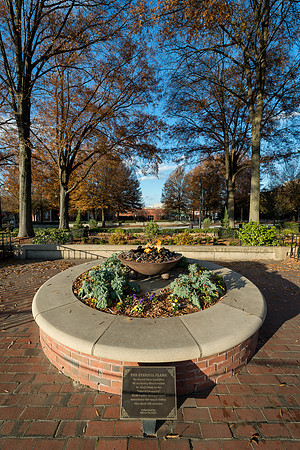
Without the tripod, some of these images become snapshots--at best. In certain locations such as museums, I expect that the policy will not permit tripods. However, during my recent trip to the Southeast, I was surprised and disappointed by a few of the locations at which tripods were prohibited. Surprise Situation #1 - The Martin Luther King, Jr. National Historic Site: I assumed that tripods would be prohibited inside the Visitor Center. However, I did not expect to be told to put my tripod away while shooting outside in the Peace Plaza. It was about 4:00 PM on a weekday and I was the only person at the plaza. I was composing a photo of the Eternal Flame when I noticed a park ranger approaching me. He informed me that tripods weren't permitted and asked me to fold it up immediately. I asked him my why tripods weren't allowed outside as this was the first time I encountered such a policy within a National Park site. He said that the tripod looked "too much like a weapon" and that "this is the America we now live in". So, it's OK to walk around with something that resembles a weapon--but it's not OK to place a camera on it to make it obvious that it's a tool for photography?
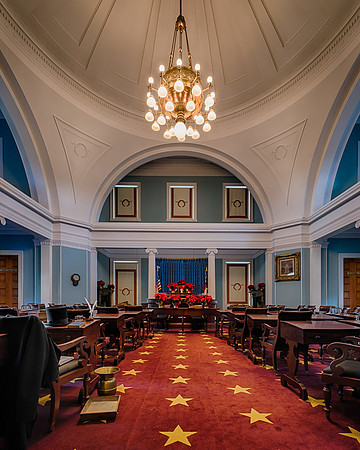
Surprise Situation #2 - The North Carolina State Capitol As I entered the North Carolina State Capitol building, I was surprised when the security guard told me that it was OK to carry the tripod into the building, but not OK to place the camera on top of it to take photographs. The reason this is so surprising is that North Carolina is the only capitol with a tripod restriction of the 39 capitol buildings that I've toured so far. I revisited twice more--hoping that a combination of a different security guard and entering the building during a quiet time might change the outcome. During my second attempt, I was the only person in the building--but the tripod was still not permitted. It was frustrating to try to capture images of the chambers by hand--when my tripod was sitting on the floor right by my side.
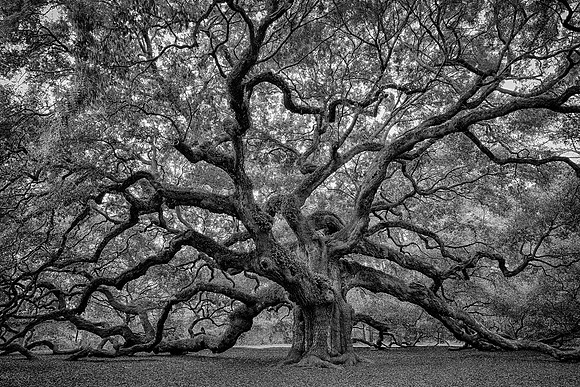
Shocking Situation #3 - Angel Oak Tree Park This one takes the cake! I arrived at Angel Oak Tree Park as soon as the gates opened on a Monday in mid-December in hopes of capturing some nice images of this massive oak tree outside of Charleston, South Carolina. Things worked out as planned as I was the only one at the nature park. I immediately got set up and started taking bracketed exposures of the tree. The tree was backlit, so multiple exposures would help extend the dynamic range of the light that the sensor could capture. Also, the scene wasn't very bright, so I was using relatively long exposures to keep my ISO setting low for better image quality--too long for me to handhold the camera. To my surprise, tripods aren't permitted at the nature park. This was the first time that I have ever experienced a situation where tripods weren't allowed in an outdoor park--a forest! Someone speculated that the reason for the policy is to protect the trees against root damage caused by the impact of the tripod legs. That reason sounds absurd to me. My tripod weighs about three pounds with the weight spread among three legs. I weigh closer to 200 pounds with the weight spread between two legs. If tripods are banned, why aren't people banned? Fortunately, I didn't learn about the tripod policy at Angel Oak Tree Park until after I was done with my shooting. So, the biggest tripod surprise of the trip wasn't a disappointment at all!
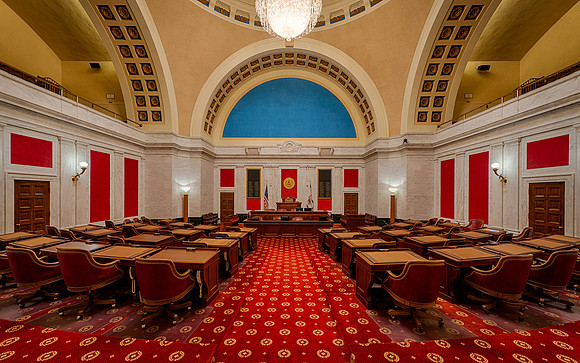
Frame Within a FrameOne of the common compositional techniques in photography is framing the subject. I used this technique quite often during my last trip through the Capital Cities of the Southeast. Here's an example of framing a scene from the Senate chamber of the State Capitol in Charleston, West Virginia: I started from the chamber floor:
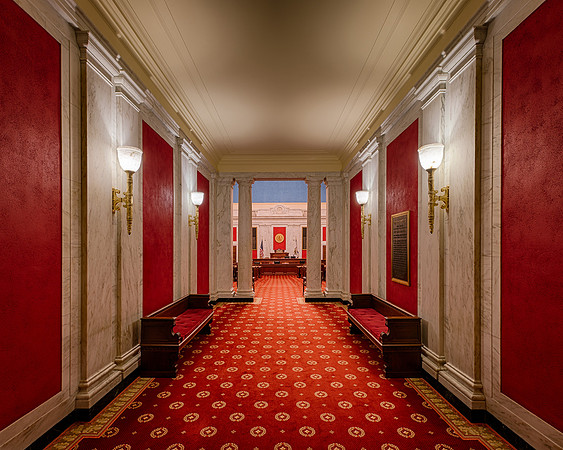
Then, I backed up several feet to include part of the corridor as it enters the chamber:
Finally, I backed up a little further, propped the doors open and captured an image with yet another frame:
I like each of the three photographs, but I think the third one offers a more unique viewpoint. I try to view scenes from a variety of perspectives. This particular sequence of images reminded me of one of my favorite broadcasters of all-time. I listened to Jack Brickhouse announce countless games for the Chicago Cubs. And, he is well known for his homerun call: "Back...back...back...Hey-Hey!!" "A Look Through My Lens" published for 2014Each year, I create a book featuring my favorite images from the year. More than 150 photographs are included in this 160 page book for 2014. You may CLICK HERE to view a full preview of this year's book. It's most effective to view the images with pages of the book expanded to fill your monitor. I use Blurb to create my books. I'm very pleased with the quality of the product--from the binding and paper to the image quality. Producing such a small quantity of books makes the per unit cost very high. I make these available for purchase at the base cost from Blurb. Often times, promo codes are available through a Google search to lower the cost by 15 to 20%. This is the seventh annual "A Look Through My Lens" book that I've created. I always wonder if I'll capture enough decent photographs in the upcoming year to keep this streak alive! I hope that there will be another book for 2015. At some point, I plan to create a book dedicated to the State Capitol buildings.
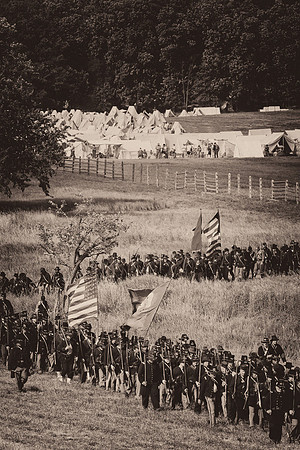
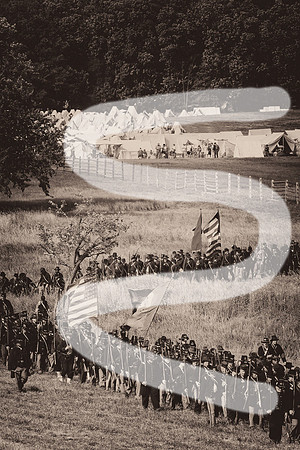
Gettysburg S-CurveIncorporating a S-curve into the frame can really strengthen the composition of a photograph. S-curves can appear when you least expect them. I happened to notice one developing during a battle reenactment in Gettysburg, Pennsylvania. In fact, it developed into a double S-curve!
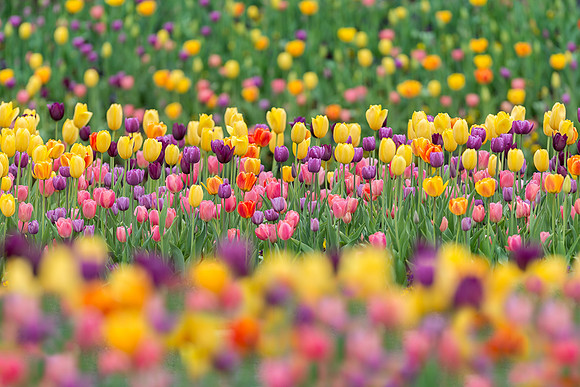
Layers for DepthIn the cold of winter, sometimes it's good to look back on one of my Spring photo shoots... One way of creating depth in a photograph is to include foreground, middle and background elements within the frame. I saw an opportunity to accomplish just that during my visit to the Chicago Botanic Garden. Probably the most impressive display of tulips was located right at the entrance station to the park. I positioned myself on one side of the street and focused on the tulips that were planted on the center island of the road. With the camera positioned very low to the ground, I was able to eliminate the street from view. While composing this picture, I made sure to frame the center island tulips with the tulips planted in the bed directly in front of me. I also included enough tulips from across the road to frame the top of the image. By using a very wide aperture (f/2.2), only the tulips planted on the center island remain sharp, while the tulips in the foreground and in the background are blurred. This narrow field of sharpness also helps focus the viewer's attention on my primary subject. Because f/2.2 is such a wide aperture, it enables a faster shutter speed (1/800th)--even at the low base ISO of 100 (for optimal image quality). However, since this is a stationary subject, I secured the camera/lens to a tripod, locked the mirror up and pressed a cable release to eliminate any camera shake.
Carlsbad Caverns to MyselfApparently, I visited Carlsbad Caverns during its slow season--between Thanksgiving and Christmas. Of course, the caverns are very dark, so I knew that a tripod would be required to capture any decent photographs. Fortunately, tripods are allowed throughout much of the cavern. However, tripods are not allowed in certain caverns--especially the ones that are accessible only through a guided tour. I think the concern is that photographers with tripods will get in the way of the tour participants and slow things down. Rather than take the elevator down to the main cavern, I decided to walk through the natural entrance and hike the 1 1/4 mile, well maintained path, 800 feet down to the main cavern. I'm glad I did as there is much to see along the way. As I was approaching the natural entrance, a ranger greeted me and asked to see my entrance pass. He asked me if I planned to take the 1.5 hour Kings Palace tour later that day. I asked him if I would be able to use my tripod on that tour. He replied that tripods are not allowed, but since he was leading that tour and the crowds were so thin, he might be able to make an exception. He said that if I made it back up to the Visitor Center by 2:00 pm, I could check with him again about the tripod before the tour got started. It took me a few hours to work my way through the natural entrance and down to the main cavern as there was much to photograph. I reached the lower elevators by 1:45 pm and quickly made my way back to the Visitor Center to check in with the ranger. He granted permission for me to shoot with the tripod! Although there were only about 250 visitors in the Caverns that entire day (which I guess is a very low number), there were still enough people on the guided tour to make photography difficult. Of course, most people were oblivious to my camera. They would walk in front of the lens toward the end of very long exposures or would destroy my pictures by flashing the scene in the middle of my exposure. The ranger noticed the difficulties that I was experiencing. He approached me and suggested the following solution. The ranger would lead the group. I would be the trailer. So, as the entire group would leave one room to enter another, the ranger would let me trail behind to have the cavern to myself for five or ten minutes. Then, I would catch up and we would repeat the process through the four rooms included in the tour! This allowed me to capture images that only other rangers would have access to capture. At the end of the tour, the ranger temporarily forgot that I was trailing the group--and nearly locked the gate at the exit of the last room. If I hadn't caught up just in time, or the ranger hadn't remembered me, I would have spent the night 800 feet below the ground in complete darkness! Once the tour was over, I spent a couple of more hours in the main cavern. As the cavern neared its closing time (5 pm), it became evident that I was the only one left down there. A ranger was doing one last sweep of the trail. He came up behind me and told me it was time to leave. We walked for ten or fifteen minutes together towards the elevators while he allowed me to stop occasionally for a few last photographs. Then, the two of us got on the elevator and left an empty Carlsbad Caverns behind for that December evening.
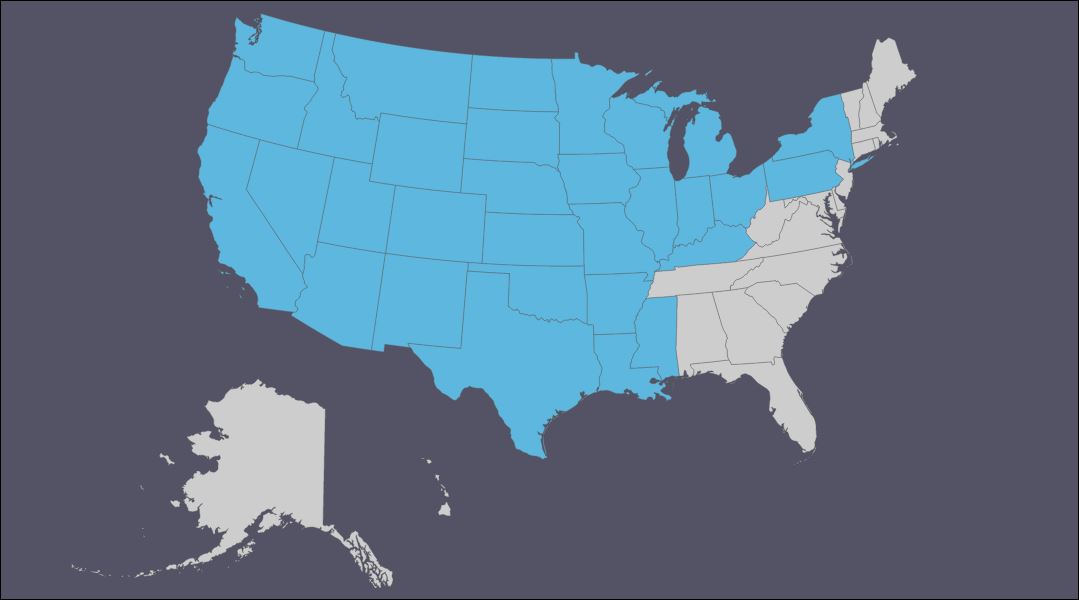
The Capitol That Isn'tSo far, I've photographed 31 State Capitol buildings. Click here to view the photographs by state. Following is a map with the capitols that I've visited in blue:
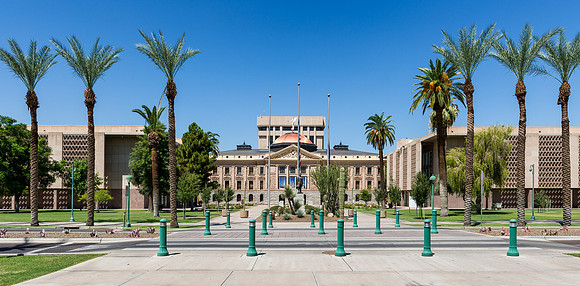
Most recently, I visited the Arizona State Capitol in Phoenix:
Although this kind of looks like a capitol building, it really isn't! The Arizona Capitol building with the bronze dome is now a museum. Various functions of government once took place in this building, but the building with the bronze dome on top now serves strictly as a museum. To me, considering this building to be a State Capitol building seems like cheating! Technically, the Old Arizona State Capitol is part of the capitol campus. That tall building just behind it is the Arizona State Capitol Executive Tower. And the Senate and House of Representative chambers are housed in the buildings to the left and right of the Old Arizona State Capitol. I wasn't permitted to enter the Executive Tower. Fortunately, I was allowed to enter and photograph the two chambers:
Another drawback of the Arizona State Capitol is that the front of the building is blocked by a lot of stuff--palm trees, monuments, posts, the street, etc. This isn't at all typical of the capitols that I've visited. Most make sure that the building is prominently displayed. Although I enjoyed my visit, I must rank the Arizona State Capitol as 30th out of the 31 capitols that I've visited so far. I apologize to Nevada for continuing to hold the bottom slot. |